


A 12 volt Bluetooth receiver is the simple fix for a stereo that sounds fine and has no wireless input: an older car head unit, a boat amplifier, or a shop radio wired to a battery. The short answer to which one to buy comes down to three checks. Match the audio output to your gear: RCA for an amplifier, 3.5mm AUX for most head units. Confirm the voltage rating covers your system, and check for a switched trigger so the unit powers down with the ignition.
What follows explains what these units do, sorts the labels (receiver, adapter, FM transmitter), and maps the placements (cars, boats, and home systems) before getting to the wiring that keeps a dead battery out of the picture. The factory stereo stays put, and every suggestion works with equipment already installed.
What Is a 12 Volt Bluetooth Receiver?
A 12 volt Bluetooth receiver is a small unit that takes audio in over Bluetooth and hands it to an amplifier or powered speakers through a wire. Your phone transmits; the receiver receives and converts. Inside, a Bluetooth chipset decodes the stream and a digital-to-analog converter turns it back into the analog signal a line-level input expects. Power comes from the vehicle’s 12V system instead of internal batteries.
The wireless side follows a single standard: the Bluetooth SIG maintains the specification these units implement. Audio travels over the 2.4 GHz band using the A2DP profile. SBC is the baseline codec; aptX and LDAC appear as optional upgrades where both devices support them. Chipset generation (Bluetooth 5.0 through 5.4 at the time of writing) mainly affects connection stability and codec options, not loudness.
That wired, powered-from-the-system design separates this category from battery-powered dongles. A 12 volt Bluetooth receiver becomes part of the installation: its output feeds the same input a CD changer once used, and its wake-and-sleep behavior follows the ignition rather than an app.

Receiver, Adapter, or FM Transmitter
Listings mix three labels, and the fastest way to sort them is signal direction. A receiver brings audio in, from phone to stereo. A transmitter sends audio out, from a source to headphones or speakers. Adapter is the umbrella word for either, usually packaged for one plug; our Bluetooth Transmitter vs Receiver explainer covers the direction question in depth.
An FM transmitter solves the same problem by a different route. It draws power from the cigarette lighter and takes your phone’s audio over Bluetooth. Then it re-broadcasts on an empty FM frequency so the factory radio can tune in. Setup takes under a minute, which explains its lasting popularity in work trucks. The compromise is the FM band itself: less audio detail than a line-level wire, and a clear frequency in a city can take patience.
A wired 12 volt Bluetooth receiver asks more of the installation and returns a cleaner signal path in exchange. If the head unit or amplifier has any auxiliary input, wired tends to sound better and does not depend on finding a clear frequency. If the radio has no input jack at all, an FM unit is often the remaining option short of replacing the deck.
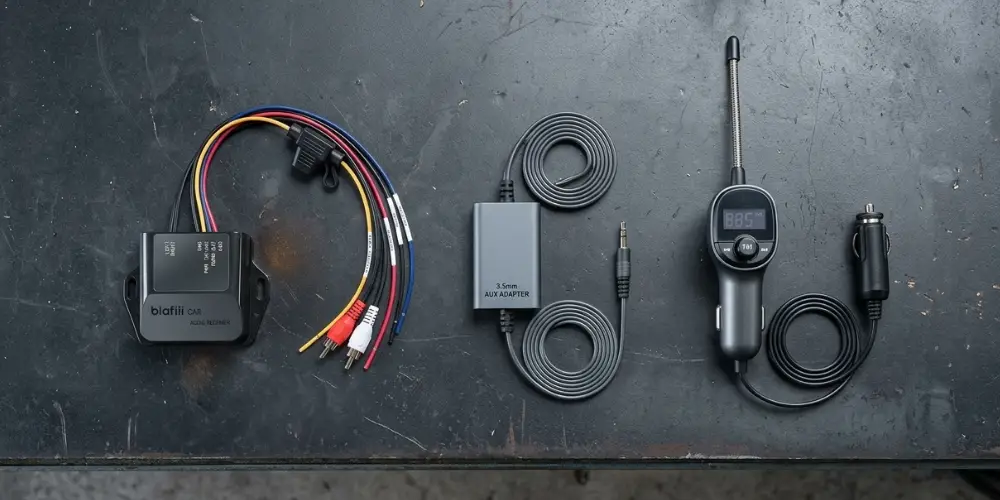
Where a 12 Volt Bluetooth Receiver Fits: Cars, Boats, and Home Speakers
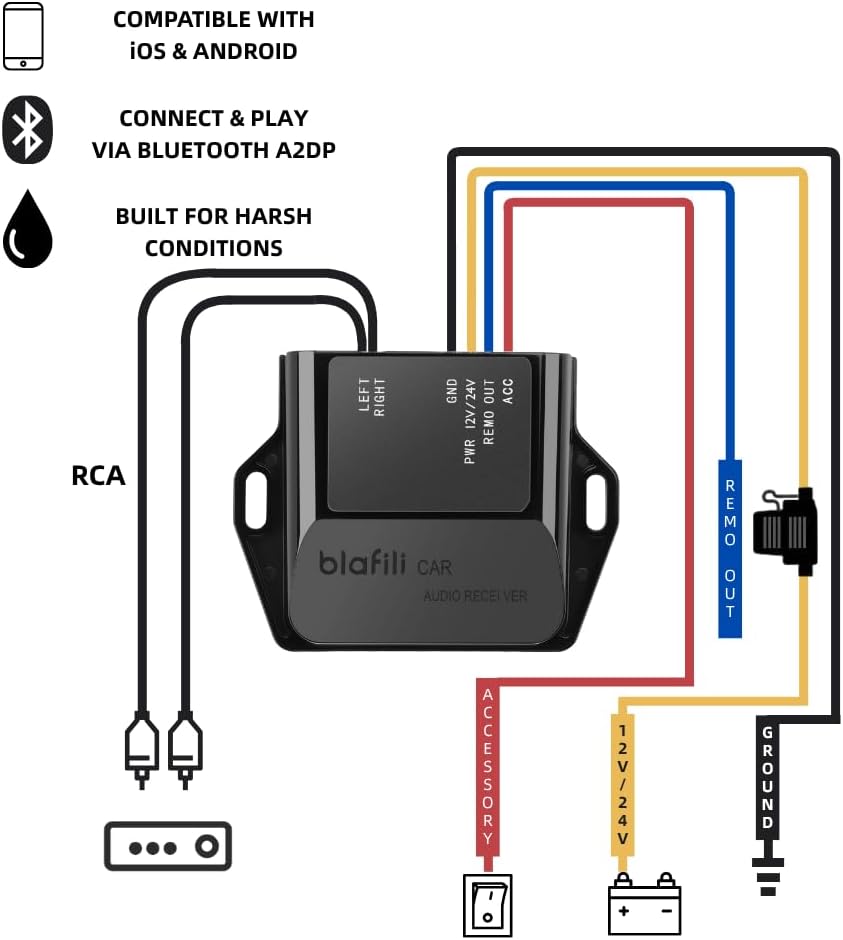
Older vehicles are the classic case. A 1990s or early-2000s deck with CD or cassette and nothing wireless accepts a receiver through its AUX jack, or through RCA inputs when an amplifier is part of the build. Classic-car owners often choose this route because the original radio stays in the dash. The blafili CAR Bluetooth 5.2 Receiver, for example, feeds an amplifier through an RCA output and runs on 12V and 24V systems. An ACC/ignition trigger switches it on with the car.
Boats share the same 12V electrical scheme. Many marine head units and amplifiers carry AUX or RCA inputs, so the hookup looks identical. Placement does the weatherproofing: mount the unit clear of spray and direct sun; few consumer Bluetooth receivers carry a formal marine rating. A 12 volt Bluetooth receiver install on a boat follows the same wiring rules as one in a car, covered in the next section.
Home audio works too, with one voltage caveat. A 12V receiver can run from a 12V DC power supply. Its output then feeds the AUX or RCA input on a home amplifier or a powered pair of speakers. If the living room is the real project, our guide on how to add Bluetooth to an old stereo covers wall-powered units in more depth.

blafili CAR Bluetooth 5.2 Receiver
Upgrade your vehicle audio with wireless Bluetooth streaming. blafili CAR connects to your amp through RCA output and works on 12V/24V systems—requires ACC/ignition trigger for operation.
Which Input Matters: RCA, 3.5mm AUX, or Hardwired USB
Audio inputs decide both sound quality and how permanent the install feels. Most 12 volt Bluetooth receivers offer one of three output types, each suited to a different host system.
| Output | Plugs into | Strengths | Watch for |
|---|---|---|---|
| RCA (stereo pair) | Amplifier inputs on car, marine, and home amps | Clean line-level signal; the standard on amplifiers for decades | Needs two cables and an amp; will not plug into a front-panel AUX jack |
| 3.5mm AUX | Head-unit AUX jacks, powered speakers | One cable, works nearly everywhere | Input quality varies between decks; keep phone volume mid-range and let the amp do the work |
| Hardwired USB | Head units whose USB port accepts audio | One cable carries audio and charging | Many car USB ports are power-only; confirm the port reads audio data before counting on it |
RCA is the pair of color-coded plugs, red for the right channel and white (or black) for the left. That interface has carried line-level audio between hi-fi components for decades; the RCA connector entry covers its history and wiring convention. When an amplifier anchors the system, RCA output is the connection to prioritize. Our guide to Bluetooth RCA receivers goes deeper on that pairing.
A 3.5mm AUX jack is the most common input on older head units; using it takes one cable, and the background lives in our Bluetooth from AUX guide. Hardwired USB looks similar and often disappoints: unless the head unit’s manual states that the port accepts audio, assume it is charge-only.
How to Wire Power, Ground, and Remote Leads
Three leads decide the install: power, ground, and the switched trigger. Power and ground feed the unit. The trigger, usually labeled ACC or remote, tells it when the system is awake. Connect it to a source that goes live with the ignition, and the receiver wakes when you start the car and sleeps when you park.
Skip that last connection and the failure has a name: parasitic drain. Installer forums tell the same story over and over, most often a 12 volt Bluetooth receiver whose trigger lead landed on a wire that stays hot with the key off, or on a thin signal wire that cannot carry the load. The outcome is a battery that dies after a few days of sitting. A multimeter and the vehicle’s wiring diagram settle any doubt about which wire is which.
If the receiver includes a microphone for hands-free calling, mount it near the driver and test a call before the trim panels go back on. Echo complaints usually trace to a mic buried under the dash or routed alongside a power wire. Routing audio cables on the opposite side of the car from the amplifier’s power run also keeps alternator whine out of the music.
A Pre-Order Checklist for 2026
Marketplace listings for a 12 volt Bluetooth receiver bury the details that matter, so verify five things on the product page rather than the photos. Work down the list in order and mismatch-driven returns mostly disappear.
- Output vs input. RCA out for an amplifier, 3.5mm for a head-unit AUX jack; adapter cables exist but add a failure point.
- Voltage rating. 12V-only covers most cars; look for 12V/24V if trucks or boats are in the picture.
- Switched trigger. ACC or remote-wire support, so the unit powers down with the ignition instead of draining the battery.
- Codec and version. SBC is the baseline everywhere; aptX or LDAC matter only if your phone supports them too.
- Documented compliance. Any receiver sold in the United States falls under FCC rules for 2.4 GHz radios; listings that state this tend to document the rest of the specs as well.
Five checks in that order, and a 12V Bluetooth receiver slots into an old system in an afternoon. The original stereo keeps its place in the dash, the phone becomes the source, and the visible change is one more input doing its job. That quiet swap is the goal.
FAQ
What is the difference between a Bluetooth adapter and a Bluetooth receiver?
Manufacturers use adapter as an umbrella label for anything bridging Bluetooth and wired audio. A receiver is the specific case that brings audio in: it accepts a stream from your phone and outputs it through RCA or 3.5mm into a stereo. An adapter may be a receiver, a transmitter, or a two-in-one unit, so the label alone does not set the direction. Check which way the audio flows before ordering.
What is the difference between a 12V Bluetooth transmitter and a receiver?
Direction again, this time in a 12V system. A receiver takes audio from your phone and feeds the car or boat stereo, which is what most people adding streaming want. A transmitter does the reverse: it picks up audio from a 12V source, such as a head unit or a TV, and sends it out to Bluetooth headphones or speakers. Choose by where the sound should end up.
Is there a Bluetooth device that plugs into a cigarette lighter?
Yes, and it is usually an FM transmitter: the lighter socket provides power, the unit pairs with your phone, and it re-broadcasts on an empty FM frequency for the factory radio to tune in. Some lighter-plug units instead offer a 3.5mm or USB audio output for a wired path. The FM versions install in seconds; the wired versions trade a little convenience for a cleaner signal.
Can a 12V Bluetooth receiver be used with home speakers?
Yes, with the right power arrangement. Connect the receiver’s output to the AUX or RCA input on a home amplifier or a powered pair of speakers, and feed the unit from a 12V DC supply rated for its draw. A wall-powered home receiver is often more convenient, but a 12V unit works identically once powered.
How can I add Bluetooth to my old car?
Three routes, in rough order of sound quality. If the head unit has an AUX jack, a wired 12 volt Bluetooth receiver into that jack is the cleanest path. If an amplifier with RCA inputs is installed, use a receiver with RCA output switched by an ACC trigger. If the radio has no input at all, an FM transmitter is the remaining no-cut option, or the deck itself gets replaced.


