Solution · vintage stereo

1978 sound, 2026 source.

Give the receiver you inherited a phone input — gently, reversibly, and with the warm sound intact.

1978 sound, 2026 source.

Old receivers gain Bluetooth through the same aux input they have always had. A vintage amp or receiver with RCA (phono/aux/tape) sockets accepts a modern Bluetooth receiver without modification — you add one small box behind the rack and nothing inside the beloved chassis is touched.

This matters for Marantz, Pioneer, Sansui and their peers: the phono stage, the transformers and the character stay original. The receiver simply becomes the source your phone streams into. If your machine only has a phono input, a cheap line-level adapter protects it from a full-strength signal — the guides below cover the wiring in detail.

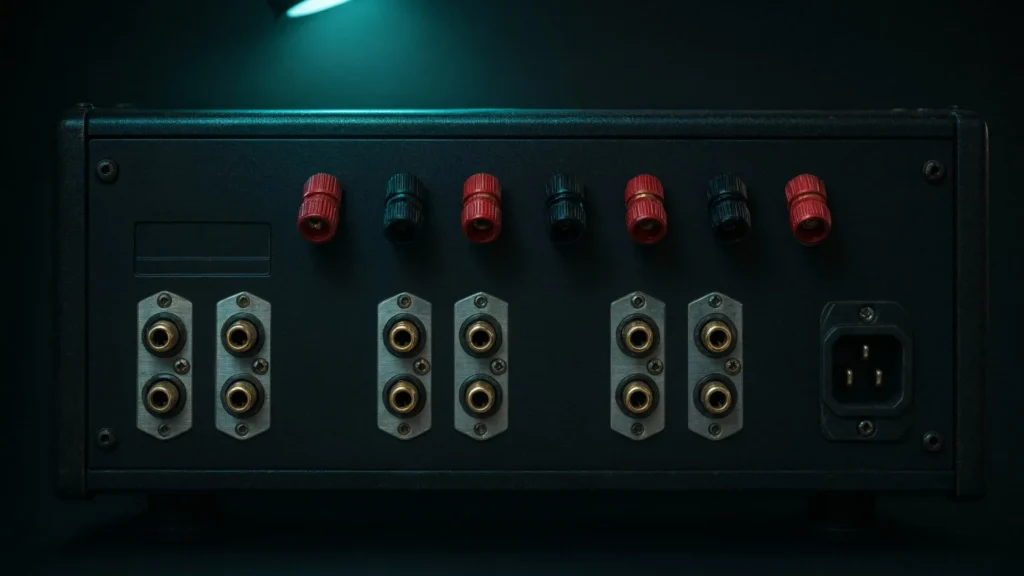
No aux, no USB, no Bluetooth The back panel has phono and tape loops — nothing a phone can plug into.
Do not want to modify it Original condition is value. Any solution must be fully reversible.
Hum and ground loops Sixty-year-old wiring plus new gear can hum — the fix is a grounding habit, not a new amp.

Three boxes, zero new cables.

Your phoneAny streaming app, any Bluetooth codec
blafili receiverRCA or XLR out — set to a gentle level
The vintage receiverAux or tape-in, tone controls as you like

Which input is safe

Vintage back panels are honest but confusing. Tape In, Aux, Tuner and Monitor are line-level and safe. The phono input is not: it expects the few millivolts a cartridge produces, so a receiver output fed directly into phono will overload the front end and sound harsh. If phono is the only option — some entry decks had no aux at all — put a phono-to-line attenuator between receiver and amp; they cost less than a cable.

Power is deliberately boring: any USB charger works. The receiver draws phone-charger levels of current, and a switched power strip lets the whole rack wake together. If the house wiring is old and the system hums, solve it at the ground: one path from turntable to amp, the receiver floating free on its double-insulated supply.

Which input is safe Vintage back panels are honest but confusing. Tape…

Keeping the character

The point of this scene is that nothing inside the chassis changes. Capacitors, transformers and the phono stage stay original — the receiver only replaces the source you would otherwise plug in. Tone controls behave exactly as the designer intended, because the signal arriving at the selector is the same line level a tuner would have delivered in 1978, just carried the last few meters by radio.

Keeping the character The point of this scene is that nothing inside…

The right box for this room.

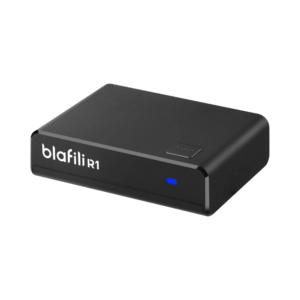
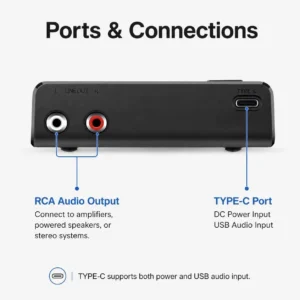
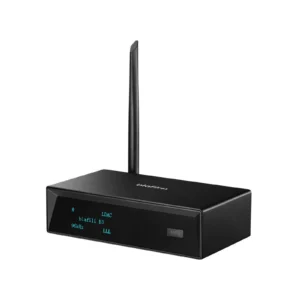
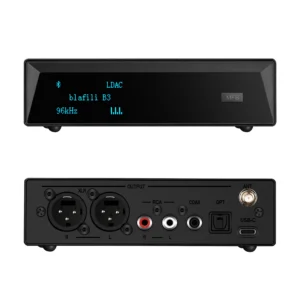
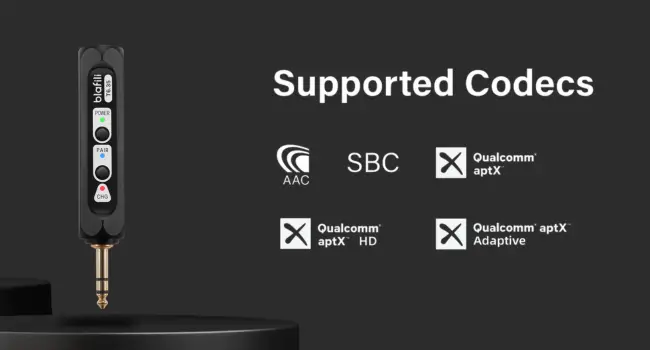
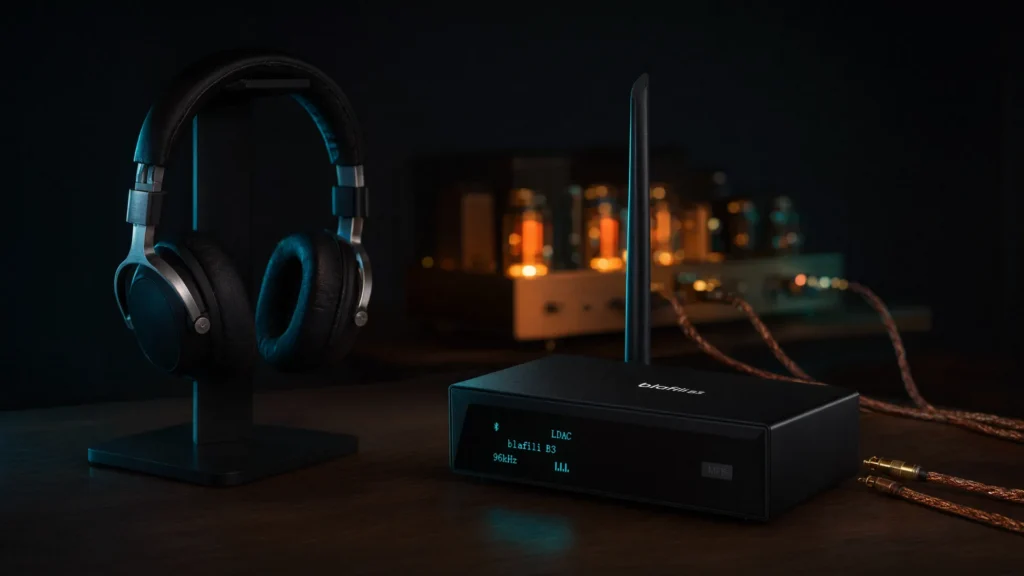
Why these two. The R1 is the museum-safe pick: one RCA pair out, USB-C power, no switches. Step up to the B3 when the system deserves optical or balanced XLR — and the OLED confirms the codec so you know the vintage iron is getting the full signal.

Set up once, forget the box.

  1. Find a line input. Aux, tape-in or tuner all work. Never feed a phono input directly without a line-level adapter.
  2. Start gentle. Set the receiver output and the amp volume low on first power-up; vintage volume pots drift with age.
  3. Kill the hum. One ground path only: if it hums, move the receiver power brick off the strip shared with the turntable.
  4. Label the input. A piece of tape saying “phone” saves the next owner of the house a service call.

Owners in the same seat.

P
Piotr
Sep 5, 2026
★★★★★★★★★★

High-Fidelity Bluetooth Audio with an amazing value

If your are looking for a aesthetically pleasing audio receiver with great output options and extensive Bluetooth codecs support (up to and including LDAC!), you've just found one.

Looks & build:
It features a minimalistic, modern looking metal case with a clear OLED panel that displays current 'source' information, paired with a single multi function button (used to turn the device ON/OFF, enter pairing mode or clear the paired devices list).
The case has a high quality finish and great attention to detail, it's nicely rounded with no rough edges.
On the back, you will find multiple output options, a sleek removable Bluetooth antenna, and a USB-C port.

Connectivity & range:
As a Bluetooth audio receiver, it supports multiple premium codecs, including LDAC (Up to 990 kbps) which will surely satisfy FLAC format fans!
With its external antenna, it provides an excellent range.
However, keep in mind that the highest quality codec - LDAC - will start to degrade if too many obstacles are in the way.
For me, a straight line distance of about 10m through two walls started to cause signal stuttering, but it was just a practical test to see how much of a beating it could take.
In normal everyday use, I tested it at distances up to 15m when streaming from my Android phone (FLAC files over LDAC), it worked perfectly.

Output options are excellent, and it's important to note that all output options are ACTIVE simultaneously if you ever feel the need to connect more than one pair of speakers.
Unlike some competitors on the market, there is no 'volume loss' compared to a direct wired connection.

Sound quality:
The manufacturer decided to use the ES9018K2M DAC chip, which offers an analytical, bright and highly detailed sound profile.

Of course, when tested on $600 pair of speakers it sounds noticeably different than on a $150 system.
I tested it using one of my favorites, "Green Grass & High Tides" by Outlaws. It sounded great on both setups, the integrated DAC managed to pump out the details - especially during the guitar solos, delivering a high fidelity experience that made even the $150 system punch above its weight!
Overall, blafili managed to deliver a great sounding device, that enriches the listening experience and allows even the lower-end speakers to shine (up to their physical limits).

What's in the Box & Manual:
Inside, you get the main device and the Bluetooth antenna.
Additionally they included both an optical cable and a USB cable.
The user manual is clear and concise.

PIN secured pairing & Power User configuration:
The device allows you to set a required PIN code for Bluetooth pairing and lets you customize the displayed Bluetooth device name.
There is also an advanced configuration application available for Windows systems. It allows you to change the pairing PIN and tweak a myriad of other advanced options if you are brave enough to dive into the settings!

Final verdict:
Bang for your buck!

*I couldn't purchase it directly from Amazon Europe, but fortunately Blafili ships to Poland :)*

blafili B3 Bluetooth Music Receiver →
H
hoplitai47
Sep 4, 2026
★★★★★★★★★★

I had been looking for a Bluetooth adapter for my speakers which lack wireless connectivity;
after browsing through many tacky, rickety-looking options, mixed-reviewed ones, and overpriced ones,
I finally stumbled on a brief YouTube review of this one, and decided to buy it.

The device is encased in a nice plastic shell with a tight fit. It's very compact and lightweight, but thanks to its rubbery feet, it stays stable.
There is only one button which allows you to enter pairing mode, clear paired devices and serves as a ON/OFF switch.
LED light serves as an indicator - blinking blue and red during pairing; the device also stays perfectly cool during use.

The connection is stable and has very good range (better than my wireless headphones).
I stream music from my laptop and Android phone and I have never experienced any disruptions even when streaming from another floor.
Using the "aptX Adaptive" codec I did not notice any drop in quality compared to a wired connection while using YouTube or basic music streaming services.
Overall it's very easy to pair and switch between streaming devices. I don't even notice that I'm using an adapter, which is a huge plus - there are no annoying added jingles, bells or voices prompts - the LED indicator is more than enough.

The included manual is clear and concise, and they even included a spare USB cable.
The device arrived safely packaged, wrapped in a bubble wrap.

*I couldn't purchase it directly from Amazon Europe, but fortunately Blafili ships to Poland :)*

blafili R1 Bluetooth Receiver →
A
Amazon Customer
Aug 29, 2026
★★★★★★★★★★

Brought the internet age to an old Marantz stereo receiver.

I purchased this unit to play Sirius XM and Amazon music from my iPhone to an old Marantz receiver in my workshop. One set of RCA plugs connected to the aux input on the receiver and then plugged into the wall using the supplied USB cable and the unit was up and running in pairing mode. The iPhone found the Bluetooth device immediately and it started playing. Five minutes tops from opening the box to music time. The sound quality was excellent. I don’t know how you could beat it for under $20. Highly recommended.

blafili R1 Bluetooth Receiver →

Asked in this room.

Can I convert my old stereo to Bluetooth?

Yes — that is exactly this page. A Bluetooth receiver into any line input (aux/tape/tuner) makes a 1970s receiver stream from a phone in minutes, fully reversible.

How do I connect my phone to a 1970s receiver?

Receiver RCA outputs into the tape or aux input, USB power from any charger, pair once. If the only input is phono, add a phono-to-line adapter first.

Will it sound as good as the original sources?

With aptX HD or LDAC the stream itself is not the bottleneck; the receivers’ DACs are quieter than most 1970s tuners ever were.