

What Is a Bluetooth Audio Receiver
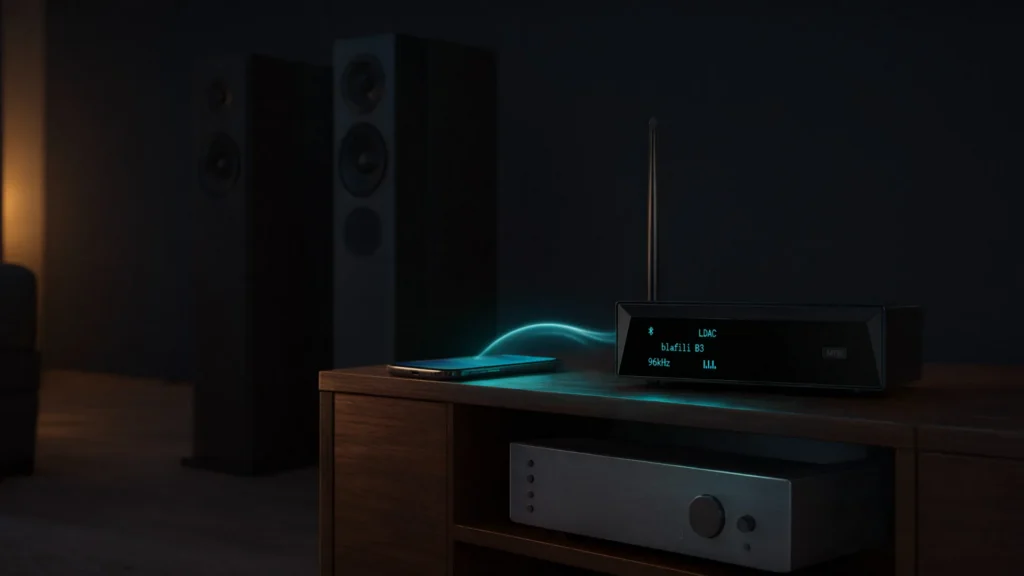
A Bluetooth audio receiver adds wireless streaming to any system with a free audio input: your phone pairs with it over Bluetooth, and it hands the music to your amplifier, powered speakers, or hi-fi through a cable. The receiver is the half of the link that listens — it decodes the Bluetooth stream your phone sends and rebuilds it as audio at its output jacks. Nothing inside your existing system changes; the receiver simply occupies one input, the way a CD player or tape deck once did.
That is why a receiver is the standard answer for gear that predates Bluetooth: home theater receivers, integrated amplifiers, vintage stereos, powered speakers, car amplifiers, and PA or studio equipment. The direction matters: if the music needs to arrive at a device, you want a receiver. If it needs to leave one — a TV to wireless headphones, a mixer to portable speakers — that is a transmitter’s job, covered in our Bluetooth transmitter guide.
The category is wider than the price tags suggest. A budget stick adds streaming to one system for the cost of a dinner out; a flagship adds a reference-class DAC, balanced and digital outputs, and every hi-res codec. The price tracks exactly the three things this guide grades — the output jacks, the codec list, and the converter inside — so the buying question is never “which is best” but “which of the three does my system actually need.”
How a Bluetooth Receiver Works: the Signal Path
Five stages, one unbroken chain. The two middle stages are where quality is decided, and both live in (or between) the devices you choose. The codec decides how much detail survives the radio trip: the mandatory SBC baseline works everywhere, while aptX and LDAC preserve more when both ends support them. The DAC and output stage inside the receiver decide how cleanly the decoded numbers become the signal at the jack — this is where hiss, dulled detail, and thin bass are won or lost. Both are covered under Key Specs below.
Receiver vs Transmitter vs Amplifier
Three boxes get confused with one another because they all sit near your stereo, but they do three different jobs:
| Role | Which way audio flows | What pairs with it | Typical job |
|---|---|---|---|
| Bluetooth receiver | In: phone → system | Your phone or tablet | Add streaming to a stereo, amp, or powered speakers |
| Bluetooth transmitter | Out: system → headphones/speakers | Your Bluetooth headphones or speakers | Send a TV, mixer, or CD player to wireless listening |
| Amplifier | Through: raises signal power to drive speakers | Nothing — it strengthens whatever is wired in | Drive passive speakers; some amps add Bluetooth themselves |
The amplifier distinction has a practical edge: if your speakers are passive, a receiver alone cannot drive them — the signal still needs amplification, either from your existing amp or from a receiver feeding that amp’s input. Powered (active) speakers take a receiver directly.
Types by Output: the Jack That Decides the Purchase
The most useful way to classify receivers is by the output they feed your system with. Match it to a free input on your gear and the rest is detail.
RCA — the home hi-fi standard
The red-and-white RCA pair is the common input on home receivers, integrated amplifiers, and powered speakers, and it has carried line-level audio between hi-fi components for decades. An RCA Bluetooth adapter is the default choice for a stereo system, and a passive 3.5 mm-to-RCA cable adapts gear whose only spare input is a small aux jack.
XLR — balanced and pro-ready
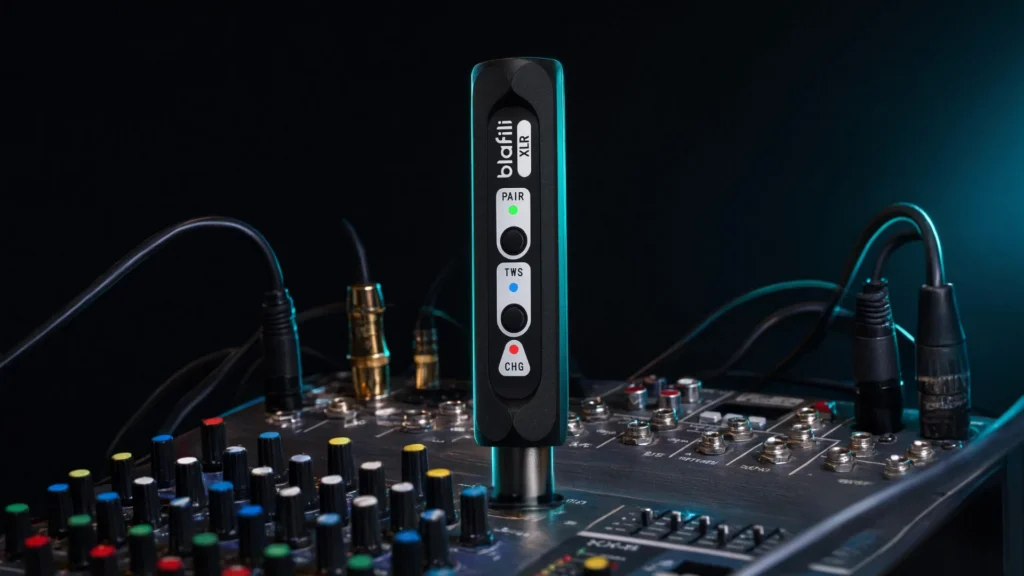
XLR is the balanced, lockable connector on mixers, PA racks, and studio monitors. A Bluetooth receiver with XLR output feeds those line inputs directly and shrugs off the hum that long unbalanced runs pick up. Note that such a receiver neither needs nor passes phantom power — it is a playback source, not a microphone.
1/4″ TRS — the amp and mixer plug
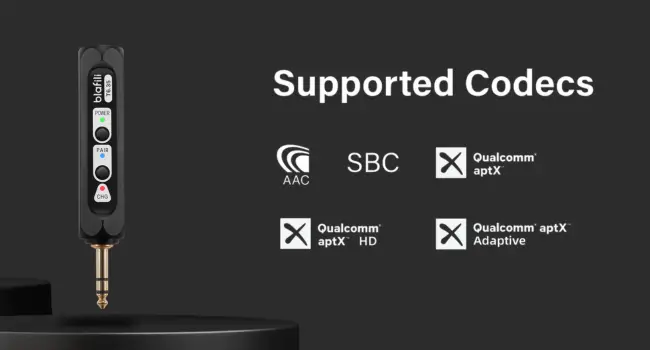
The 1/4″ (6.35 mm) plug speaks the instrument-amp and mixer dialect. Where a 3.5 mm stick would need a fragile adapter chain, a dedicated 1/4″ unit such as the blafili 6dot35 plugs straight into the jack — aptX HD/LL codecs and a built-in battery included. The full buying walkthrough lives in our 1/4″ TRS Bluetooth receiver guide.
Optical and coaxial — digital end to end
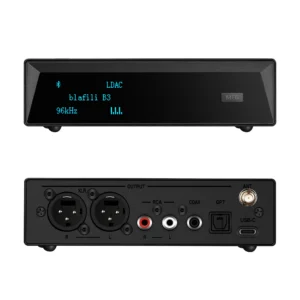
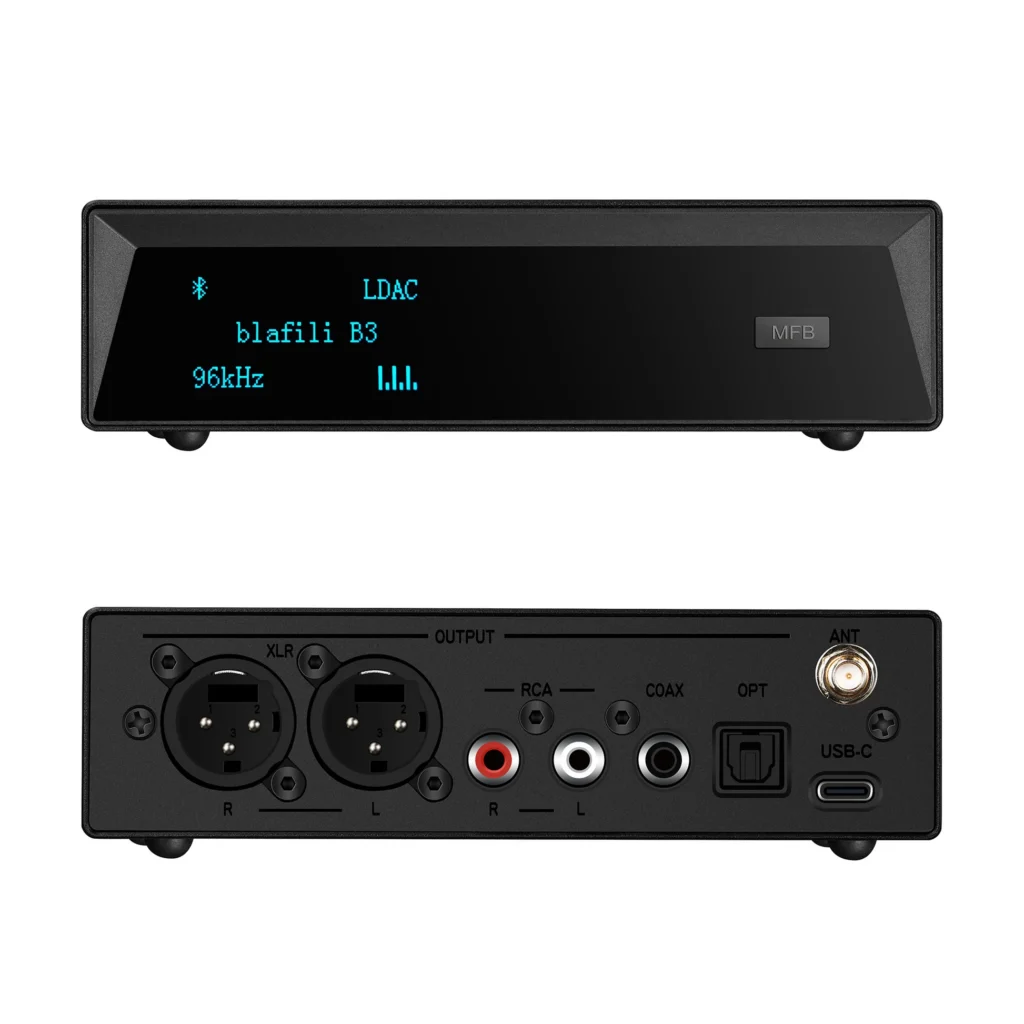
If your AV receiver, soundbar, or DAC has an optical (Toslink) or coaxial input, a digital-output receiver keeps the signal digital until it reaches your system’s own converter. The blafili B3 carries both jacks alongside XLR and RCA, so one box covers analog and digital inputs — and fiber optics pick up none of the electrical hum copper can.
USB and 12 V — power where you need it
USB shows up in two roles: as clean 5 V power (most home receivers charge or run over USB-C), and on some models as a USB audio input from a computer. For cars, boats, and trucks, hardwired 12 V/24 V units such as the blafili CAR take power from the vehicle’s switched ACC line so they sleep with the ignition instead of draining the battery — the car scene below has the details.
Key Specs That Separate Clean Receivers from Noisy Ones
Codecs. Every Bluetooth audio device runs SBC; aptX, aptX HD, and LDAC preserve more detail when both ends support them, and the negotiation always lands on the best codec the two devices share — a receiver’s codec list is only half the deal. The full numbers are in our Bluetooth audio codec comparison.
DAC and output stage. Every Bluetooth receiver contains a digital-to-analog converter, and its quality sets the ceiling on hiss and detail. If a listing names neither the DAC chip nor a signal-to-noise figure, treat that as information. Our what-is-a-DAC explainer covers the concepts, and the Bluetooth DAC guide goes deep on hi-res wireless sound.
Latency. Music has no sync reference, so delay is irrelevant for listening — it only matters when a picture is involved. aptX Low Latency holds lip-sync to 32–40 ms; plain SBC can drift far enough to distract on video.
Range. Real-room Bluetooth is a ~10 m / 33 ft technology; better radios and antennas reach 30 m / 100 ft in line of sight. Walls, metal, and busy 2.4 GHz air shrink every figure — keep the receiver clear of the Wi-Fi router.
Power. Home units run on USB or a small wall supply; car units need 12 V (24 V in some trucks and boats) with an ACC trigger so they switch off with the ignition. For permanent installs, pass-through power (use while plugged in) matters more than battery hours.
How to Choose a Bluetooth Receiver by Scene
Scenes exist because the wiring differs more than the boxes do: a home system wants the right jack, a vintage system wants a safe input and clean power, pro gear wants balanced lines, and a car wants switched power. Find yours below — each links a full playbook.
Home hi-fi
Start from the free input, not the product listing: RCA inputs take an RCA receiver, optical or coaxial inputs deserve the B3’s digital outputs, and a single spare aux pairs happily with a 3.5 mm-to-RCA cable. The scene playbook is in home hi-fi.
Vintage stereo
Older receivers reward the same input-first logic, with one hard rule: never a phono input (see Common Mistakes). The walkthrough for 1960s–1990s gear is in our guide to adding Bluetooth to an old stereo, with period-specific notes in vintage stereo.
Pro audio
Mixers, PA racks, and studio monitors want balanced lines: an XLR-output receiver feeds them directly without adapter chains that hum and fall out. The setup patterns are in pro audio and our Bluetooth receiver for audio mixers guide.
Car audio
A 12 V receiver hardwired to ACC/GND with an RCA or aux output adds streaming to a classic head unit — battery-drain safety comes from the ACC trigger, not from remembering to unplug. The install guide is in car audio.
Common Mistakes to Avoid
- Buying the wrong direction. A transmitter sends a system’s output to headphones; a receiver brings your phone’s audio in. Check the arrow on the box before the price.
- Plugging into the phono input. It applies turntable-only equalization and expects a signal thousands of times smaller — a Bluetooth receiver there distorts immediately. The input-by-input safety chart is in the old-stereo guide.
- Setting gain in the wrong order. If sound arrives distorted, lower the phone’s volume first, then raise the stereo’s — the reverse order amplifies the noise floor along with the music.
- Powering from scattered outlets. A low hum that follows the adapter usually means a ground loop — one power strip fixes most cases, and the rest are covered in the RCA guide’s hum fixes.
- Trusting codec badges alone. aptX printed on one device means nothing unless the other end negotiates it too — check both spec sheets.