

aptX Low Latency is a Bluetooth audio codec built for one job: keeping wireless sound locked to what you see and do. Qualcomm, which owns the aptX family, specs it at approximately 40 ms of end-to-end delay, the rate the company describes as what is needed to synchronize audio with on-screen visuals (Qualcomm aptX product page). Standard Bluetooth chains routinely run four to eight times slower. This page covers what the codec does, how its latency compares with SBC, AAC, and plain aptX, why it only works when both ends of the link support it, and what to check before you buy gear that promises it.
What Is aptX Low Latency?
aptX Low Latency is a variant of Qualcomm’s aptX codec family, tuned for speed instead of peak fidelity. It carries consistent 16-bit audio and, because it is a sample-based codec that packs audio samples into Bluetooth packets efficiently, the encoding and decoding stages add very little waiting time. Qualcomm’s official figure is approximately 40 ms of latency for an audio adapter running the aptX Low Latency encoder in an embedded Bluetooth device. Independent listings of the codec put its end-to-end delay at 32 ms over the Bluetooth link, and for context on how tight that window is, broadcast television practice keeps audio within roughly +40 to -60 ms of video before viewers flag the drift as out of sync (Wikipedia’s aptX reference).
A codec sitting near the bottom of that band is the difference between lip movements that match syllables and a film that feels dubbed. Standard SBC and AAC chains, as the comparison table below shows, sit well outside it.
One boundary note so you read the right article: our earlier comparison of aptX vs. aptX HD sound quality handles the fidelity side of the family, bitrate for bitrate. This page stays on the latency side, where the real question is how quickly the audio arrives.
How Much Latency Do Bluetooth Codecs Actually Have?
Codec specs only tell part of the story. Your phone’s operating system buffers audio, the Bluetooth stack stacks up its own queues, and the receiving device adds decode time. So real-world delay depends on the whole chain, and measured numbers often dwarf the figures printed in marketing sheets.
The most useful public dataset on this comes from SoundGuys, which ran 100 latency tests per codec across four Android phones (2,800 data points total). Their averages: SBC at 308 ms, aptX at 316 ms, and AAC at 369 ms (SoundGuys latency measurements). The numbers show how much phone-side buffering dominates: aptX classic is engineered as a low-delay codec, yet an Android phone chain averaged 316 ms with it.
| Which codec? | How much end-to-end delay? | Where does it fit? |
|---|---|---|
| aptX Low Latency | Around 40 ms per Qualcomm, 32 ms in independent listings | Video lip-sync, gaming, live monitoring |
| aptX Adaptive | Around 80 ms system latency per Qualcomm | Current default in new Android phones and earbuds |
| aptX (classic) | Codec is low-delay by design; one four-phone test averaged 316 ms | Music listening where sync does not matter |
| SBC | Typically lands near 300 ms; 308 ms four-phone average | Universal fallback every A2DP device speaks |
| AAC | Typically the slowest of the group; 369 ms four-phone average | Apple ecosystem default, including AirPods |
Read the table with “typically” in mind. A well-tuned AAC chain on Apple hardware can beat a badly buffered SBC chain on a budget phone. What the table reliably tells you is the order of magnitude each codec lands in when everything else is equal, and that only the dedicated low-latency modes sit anywhere near the lip-sync window.
Why Does aptX Low Latency Need Support on Both Ends?
Because the codec has to run twice. The transmitting device encodes audio into aptX Low Latency before sending it over the air, and the receiving device has to decode that exact format on arrival. aptX technology in general has to be incorporated in both the transmitter and the receiver, and Qualcomm’s Low Latency page describes the same requirement for this variant.
When one end lacks the codec, the two devices negotiate down to whatever they share, which usually means SBC. Nothing warns you. The music keeps playing, the spec stickers both said “Bluetooth 5.x”, and the delay quietly jumps from around 40 ms to several hundred. Silent fallback is the single most common reason people buy low-latency gear and still hear lag.
There is a second catch: availability. aptX Low Latency needed extra antenna accommodations, saw little adoption in smartphones, and was retired by Qualcomm in favor of aptX Adaptive (Wikipedia). aptX Adaptive keeps the low-latency mission with approximately 80 ms of system latency (Qualcomm’s Adaptive page), adjusts its bitrate between 279 and 420 kbps as conditions change, and is backward compatible with aptX and aptX HD, though not with aptX Low Latency. In practice, new phones and earbuds carry Adaptive, while the classic Low Latency pairing survives mainly in dedicated transmitters and receivers built for AV sync.
The generational split matters for buyers. A 2019-era aptX Low Latency transmitter still pairs with current receivers that list aptX LL, but it cannot engage aptX Adaptive, so it gives up the newer codec’s adaptive bitrate scaling between 279 and 420 kbps. Going the other way, a modern aptX Adaptive phone driving an older aptX LL headset negotiates down to plain aptX, and the low-latency modes on both devices sit unused. Matching the era of the gear on both ends is part of the compatibility check, alongside the codec names themselves.
- Check the codec list on both spec sheets, not just one. Look for the exact string “aptX Low Latency” or “aptX LL”; “aptX” alone is the classic codec.
- Verify claims against Qualcomm’s aptX product finder when a brand is vague about which variant it supports.
- Treat continuing lag after pairing as the fallback symptom: re-pair, check developer options on Android for the codec actually in use, and test with a lip-sync video.
Do AirPods Support aptX Low Latency?
No. No AirPods model decodes aptX in any form. Apple’s own support documentation states that AirPods rely on the AAC codec, and that Bluetooth connections on that ecosystem are not lossless (Apple support). Since aptX Low Latency needs support on both ends, pairing an aptX Low Latency Bluetooth transmitter with AirPods gets you an SBC or AAC fallback at several times the delay.
iPhones do not fill the gap on the other side either, since Apple devices stick to AAC for Bluetooth audio. If your listening world is Apple-shaped, low-latency wireless audio comes from gaming earbuds built around proprietary 2.4 GHz dongles, not from aptX. If you are shopping for aptX Low Latency earbuds on the Android side, the realistic picks are older gaming-leaning models, since newer releases have moved to aptX Adaptive. The same screening rule applies to aptX Low Latency headphones: the codec string has to appear on both the phone spec sheet and the headphone spec sheet, or the chain will not engage it.
Where Low Latency Earns Its Keep: Stages, Streams, and Games
Music listening tolerates a quarter second of delay without anyone noticing. Three situations do not:
- Live performance. A singer monitoring their own voice through wireless in-ears hears every millisecond. Past roughly 40 to 60 ms of round-trip delay, vocals start fighting the sound in the room and timing falls apart on stage.
- Gaming. Footsteps, reloads, and callouts are positional information. A 300 ms audio delay means you hear the engagement after the other player already won it.
- Video and streaming. Dialogue drifting behind lip movement is the classic symptom, and it is exactly the failure mode aptX Low Latency was designed to erase for phone and tablet viewing.
Livestreaming adds its own twist. Monitor your broadcast through a laggy Bluetooth earbud while talking, and what you hear of your own voice trails far enough behind your speech that hosts talk over each other without meaning to. Streamers who cue off their own monitoring mix feel every millisecond of the return path, even when the delay itself stays hidden from the audience.
Live events add a transmitter-side need: getting console or mixer output to wireless gear without cables across the stage. That is where an aptX Low Latency Bluetooth transmitter earns its slot in the signal chain, and it is the same job blafili built its two transmitter models for: moving mixer and PA output to Bluetooth gear without running cables across a stage. The blafili T6.35 Bluetooth Transmitter plugs its 1/4-inch (6.35 mm) jack straight into a mixer or PA output and streams to two Bluetooth speakers at once on battery power. The blafili Bicast XLR Bluetooth Audio Transmitter takes XLR female or USB-C audio input, runs up to 16 hours per charge, and carries the aptX Adaptive codec family, which includes approximately 80 ms low-latency operation on chains that support it. For a fuller walkthrough of direction, jacks, and pairing, see how a Bluetooth transmitter sends audio from wired gear to wireless.
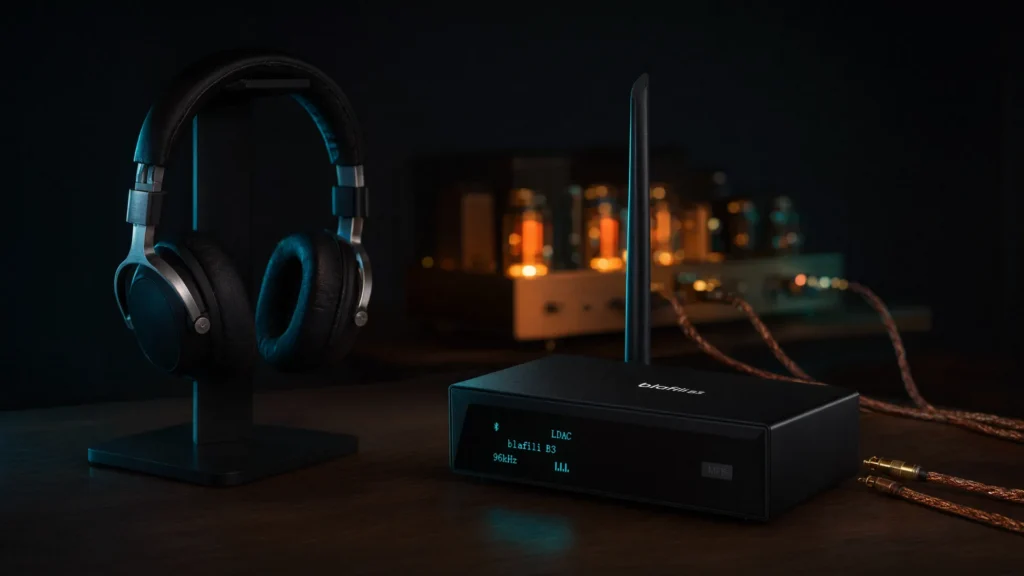
On the receiving end, codec support decides what the chain can negotiate down to. blafili’s XLR, B3, and 6dot35 receivers all list aptX LL among their supported codecs, alongside aptX HD, aptX, AAC, and SBC, so a compatible source can engage the low-latency path instead of falling back to SBC.
How Do You Get a Low-Latency Chain Working?
Work the checklist from both directions before spending money:
- Start from the fixed end. If your headphones or receiver only list SBC and AAC, as AirPods do, no transmitter purchase will conjure aptX Low Latency out of them.
- Match the era of your gear. Older aptX LL equipment pairs with its own kind; newer Android equipment speaks aptX Adaptive at around 80 ms. Mixing eras means falling back to the shared codec, usually plain aptX or SBC.
- Test with a lip-sync video after pairing, and re-check on Android developer options which codec actually negotiated. Trust the measurement over the box.
- For stage and streaming rigs, count the whole path: instrument to transmitter to receiver to ears. The codec is one segment, and every wireless hop adds its own delay.
Around 40 ms over aptX Low Latency, or around 80 ms over aptX Adaptive, keeps audio inside the window where eyes and ears agree. Anything slower works fine for background music and fails the moment sync matters, so verify both ends of the chain before you buy the gap you actually have.