

What is Bluetooth? In one line: a short-range radio standard that lets two devices swap audio, calls, and data over the 2.4 GHz band with no cable in between. Phones, headphones, car stereos, watches, and laptops all speak it. The pairing, the channel hopping, and the audio compression all happen in the background, which is why the technology usually gets noticed only when it breaks.
This explainer covers the parts people actually ask about: how the radio works, which frequencies it uses, who created it and why it carries a Viking king’s name, what the version and codec names mean, and what the standard is used for today, from earbuds to plug-in receivers that stream music into old amplifiers.
What Is Bluetooth?
Bluetooth is an open wireless standard for personal area networks: short, direct links between devices sitting a few meters apart. A trade body called the Bluetooth Special Interest Group (SIG) maintains the specification, and member companies build to the shared spec, which is why a phone from one brand pairs with a speaker from another brand with no negotiation. The radio itself, according to the Bluetooth SIG’s technology overview, streams data over 79 channels in the unlicensed 2.4 GHz industrial, scientific, and medical (ISM) band, with 1 MHz spacing between channels.
The word gets used loosely, so it helps to pin down what it names. Bluetooth is a specification, meaning a published set of rules for how radios behave: which frequencies to use, how to format a packet, how to encrypt a link, how to negotiate audio. Any manufacturer that joins the SIG can implement those rules in silicon, and many chip vendors do, so the same rules ship inside everything from budget earbuds to car head units and hearing aids.
Wi-Fi and Bluetooth share that band yet solve different problems. Wi-Fi pushes heavy traffic through a router and out to the internet; Bluetooth skips the router and links two end devices directly, at lower speed, lower power, and with far less setup. A phone can run both at once: Wi-Fi carries the video stream while Bluetooth carries the audio to a pair of headphones.
The standard also splits into two halves that matter later on this page. Classic Bluetooth, the original radio, handles continuous jobs like stereo music streaming. Bluetooth Low Energy (LE), added with version 4.0 in 2010, handles small data bursts at a fraction of the power, which is what made smartwatches, fitness bands, and item finders practical.

How Does Bluetooth Work?
Every Bluetooth link starts with pairing. One device broadcasts its presence, the other picks it from a list, the two exchange cryptographic keys, and from then on they recognize each other and reconnect on their own. That stored trust is why earbuds connect the moment their case opens near a paired phone.
A connection forms a tiny network called a piconet, with one device acting as the coordinator and the others following its clock. A phone can coordinate a headset, a watch, and a car stereo at the same time, switching attention between them in slices. Profiles keep the roles straight: A2DP governs stereo audio streaming, AVRCP handles play, pause, and track controls, and HFP carries phone calls.
Security rests on that pairing step. The keys exchanged at first contact are stored on both ends, traffic between them is encrypted, and the short range is itself a boundary: a would-be eavesdropper needs to be within radio distance, since the signal fades into noise a few rooms away. Link keys plus physical proximity are why casual Bluetooth sniffing is impractical for anyone who is not standing next to you.
Data rides the radio as small packets, and the radio changes channel constantly to dodge interference. Classic Bluetooth hops up to 1,600 times per second across its 79 channels in a scheme called frequency-hopping spread spectrum, and adaptive frequency hopping (AFH) lets a connected pair blacklist channels that Wi-Fi or a microwave oven is currently filling.
For music, the chain looks like this: the phone compresses the audio with a codec, chops it into packets, fires the packets across hopping channels, and the receiving device decodes them back into an analog signal through a digital-to-analog converter (DAC). Every Bluetooth speaker, headset, and receiver is, at heart, that decode-and-amplify chain wrapped in a plastic shell.

What Frequency Is Bluetooth?
Bluetooth transmits between 2.402 and 2.480 GHz, inside the 2.4 GHz ISM band. That slice of spectrum needs no license in most of the world, which is exactly why it is crowded: Wi-Fi routers, microwave ovens, and plenty of other wireless gadgets all sit in the same neighborhood.
The ISM band was set aside internationally for equipment that radiates without a license: industrial heaters, medical devices, and, eventually, every consumer gadget that could not afford dedicated spectrum. Regulators attached one condition, that the radio tolerate interference from its neighbors instead of complaining about it, and Bluetooth’s hopping design is a direct answer to that rule.
Classic Bluetooth divides its share into 79 channels of 1 MHz each, while Bluetooth Low Energy uses 40 channels of 2 MHz each. The constant hopping described above means a link does not park on one frequency long enough for a single interferer to kill it, and AFH steers the hop pattern around channels the pair agrees are too noisy. In a dense apartment the congestion still shows up as audio stutter, a topic this page returns to near the end.
Range depends on the radio’s power class. Most phones and headphones use the low-power class rated for around 10 meters, while higher-power designs reach up to 100 meters. Walls, floors, and the human body absorb 2.4 GHz energy, so real-world range usually lands below the figure printed on the box.
Who Invented Bluetooth?
Bluetooth was invented at telecom maker Ericsson in Lund, Sweden. Work on a short-range radio for linking phones with accessories had been running there since 1989 under technology chief Nils Rydbeck, and the principal development of what shipped began in 1994, led by engineers Jaap Haartsen and Sven Mattisson. The goal was mundane and practical: replace the cable between a mobile phone and its headset.
The idea outgrew one company fast. In 1997 Ericsson and Intel began pushing it as an industry standard, and in 1998 the Bluetooth SIG launched with five founding companies: Ericsson, Intel, Nokia, Toshiba, and IBM. The group published the first full specification, Bluetooth 1.0, in 1999, and the first Bluetooth headsets and phones reached stores within a couple of years.
Adoption was slow at the start. Early headsets were expensive, the chips were bulky, and the first spec had interoperability gaps that the SIG spent the early 2000s closing. Volume broke the cycle: once phone makers began shipping Bluetooth as a default feature, the technology stopped being a niche accessory add-on, chip prices fell, and a radio could then live inside almost anything.
Why Is It Called Bluetooth?
The name began as an in-joke that was meant to be temporary. In 1997, Jim Kardach of Intel, who was coordinating the standardization effort, suggested “Bluetooth” after a conversation about Scandinavian history with Sven Mattisson of Ericsson. It referenced Harald “Bluetooth” Gormsson, the tenth-century king who brought Denmark and Norway under one crown, as a metaphor for what the project wanted to do: unite the communications protocols of PCs and mobile phones. Kardach later said the name was “only intended as a placeholder until marketing could come up with something really cool.” The serious candidates at the time included RadioWire and PAN, and the placeholder outlived them all.
The logo carries the same reference. It is a bind rune merging the Younger Futhark runes Hagall and Bjarkan, the initials of King Harald, so the symbol on every phone’s settings screen is a tenth-century king’s monogram.
Which Bluetooth Version Do You Have?
The version number in a spec sheet tells you which feature set a radio supports, and the increments matter mostly for speed, range, and efficiency, and only indirectly for sound quality. The milestones worth knowing:
| Bluetooth version | When did it ship? | What did it change? |
|---|---|---|
| 1.0 | 1999 | First public specification; early phones and headsets |
| 1.2 | 2003 | Adaptive frequency hopping to dodge busy channels |
| 2.0 + EDR | 2004 | Higher data rates that made stereo music practical |
| 3.0 + HS | 2009 | Borrowed Wi-Fi links for bulk transfers |
| 4.0 | 2010 | Added Bluetooth Low Energy for sensors and wearables |
| 5.0 | 2016 | Longer range, faster LE transfers, larger broadcast messages |
| 5.3 | 2021 | Efficiency refinements and faster connection switching |
| 5.4 | 2023 | Encrypted advertising for large device networks |
| 6.0 | 2024 | Channel sounding for measuring true distance between devices |
For listening, the version number matters less than the codec line printed under it. A Bluetooth 5.3 phone paired with headphones that decode only SBC still streams in SBC, while a 5.0-era pair that both support aptX HD streams in aptX HD. Both ends agreeing on a codec counts for more than a newer version number.
Two practical notes on version numbers. Backward compatibility is built in: a Bluetooth 5.4 phone connects to a Bluetooth 4.2 speaker, and the link runs at the feature set both devices share. And the version lives in hardware, not in a settings menu, since it is a property of the radio chip; the spec sheet of the device is the place to check.
Classic Bluetooth vs. LE Audio: What Changed?
Headphones and car stereos sold today stream music over Classic Bluetooth using the A2DP profile. Its successor, LE Audio, runs on the Low Energy radio, was announced in January 2020, and had its specifications completed in 2022. Adoption is spreading through new earbuds, hearing aids, and phones, and the two stacks will coexist for years.
LE Audio ships with a new built-in codec called LC3. The SIG’s LE Audio pages describe LC3 as exceeding SBC audio quality even at a 50% lower bit rate, which points to either better sound at today’s battery life or the same sound with noticeably longer playtime. LE Audio also adds Auracast broadcast audio, where one source such as a gate announcement system or a gym audio feed can transmit to an unlimited number of receivers.
| How do the stacks compare? | Classic Bluetooth | LE Audio |
|---|---|---|
| Which radio does it use? | BR/EDR, the original design | Bluetooth Low Energy |
| How many RF channels? | 79 channels of 1 MHz | 40 channels of 2 MHz |
| Which built-in codec? | SBC, with AAC, aptX, and LDAC optional | LC3 |
| Can it broadcast audio? | Point-to-point and limited multipoint | Auracast to an unlimited audience |
| How much power does it draw? | Moderate | Lower, sized for hearing aids and small earbuds |
| Where do you meet it today? | Headphones, speakers, car stereos | Newer earbuds, hearing aids, flagship phones |
What Is Bluetooth Used For?
The standard was built to kill short cables, and by now it has claimed most of them. The everyday uses:
- Audio streaming: headphones, earbuds, portable speakers, car stereos, and home receivers playing music from a phone or tablet.
- Hands-free calls: car kits, headsets, and speakerphones carrying voice with remote call controls.
- Wearables: smartwatches and fitness bands syncing notifications, health data, and calls with a phone.
- Peripherals: keyboards, mice, and game controllers connecting without USB dongles.
- Smart home and tracking: door locks, sensors, and item finders using Low Energy to run for months on coin cells.
- Legacy file transfer: the “receive a file” dialog of 2000s phones, now mostly retired in favor of cloud sharing.
Audio is where the standard touches this site’s home turf. Plenty of good equipment, from home amplifiers to mixing consoles and powered PA speakers, was born before wireless streaming and has no radio inside. A plug-in Bluetooth receiver fills the gap: it pairs with the phone, receives the stream, decodes it through its internal DAC, and feeds the analog signal into the amplifier’s input.
The blafili B3 Bluetooth Music Receiver shows the pattern at full size: a Bluetooth 5.1 receiver built on a Qualcomm QCC5125 chip that decodes LDAC, aptX HD, aptX Low Latency, aptX, AAC, and SBC, then outputs through balanced XLR, RCA, optical, or coaxial to match whatever sits downstream. If you are weighing which Bluetooth receiver fits a home stereo, the codec list and the output types are the two rows worth checking first.
Balanced setups get a smaller, dedicated tool. The blafili XLR Bluetooth Audio Receiver outputs through a balanced XLR male connector with aptX HD, aptX Low Latency, aptX, AAC, and SBC on board, and its built-in battery runs for up to 10 hours, which answers the question of how to add Bluetooth to a mixer when the console offers XLR inputs.
The receiver route costs a fraction of replacing the amplifier, and it keeps the existing signal chain intact: the phono stage, the speaker tuning, and the console routing all stay in place while the Bluetooth radio handles only the last hop from the phone. That division of labor, wireless for the source and wired for everything after the DAC, mirrors how wireless headphones are built internally.
The traffic can also flow the other way. A Bluetooth transmitter takes an analog output, such as a mixer’s aux send, and streams it to wireless speakers or headphones; how a Bluetooth transmitter sends a mixer to wireless speakers is covered in a dedicated guide on this site.

Bluetooth Codecs, from SBC to LC3
What Is a Bluetooth Codec?
A Bluetooth codec is the compression scheme that shrinks audio so it fits the radio link, then rebuilds it at the receiving end. Uncompressed CD audio is far too wide for a Bluetooth connection, so every stream gets compressed, transmitted, and decoded in real time, and the codec choice sets how much musical detail survives the trip.
SBC is the baseline built into the A2DP profile, so any compliant audio device can fall back to it, and it sounds better than its reputation at higher bitrates. For the full picture, read how the SBC codec works and where its limits are.
Above the baseline sit the optional codecs, and each has a sponsor. AAC is the default on Apple gear. Qualcomm’s aptX family spans classic aptX, aptX HD for higher detail, aptX Adaptive for variable-rate streaming, and aptX Low Latency for keeping sound synced to picture. Sony’s LDAC pushes the most bits: it reaches up to 990 kbps and steps between 330, 660, and 990 kbps as link quality changes, with support built into Android since version 8.0.
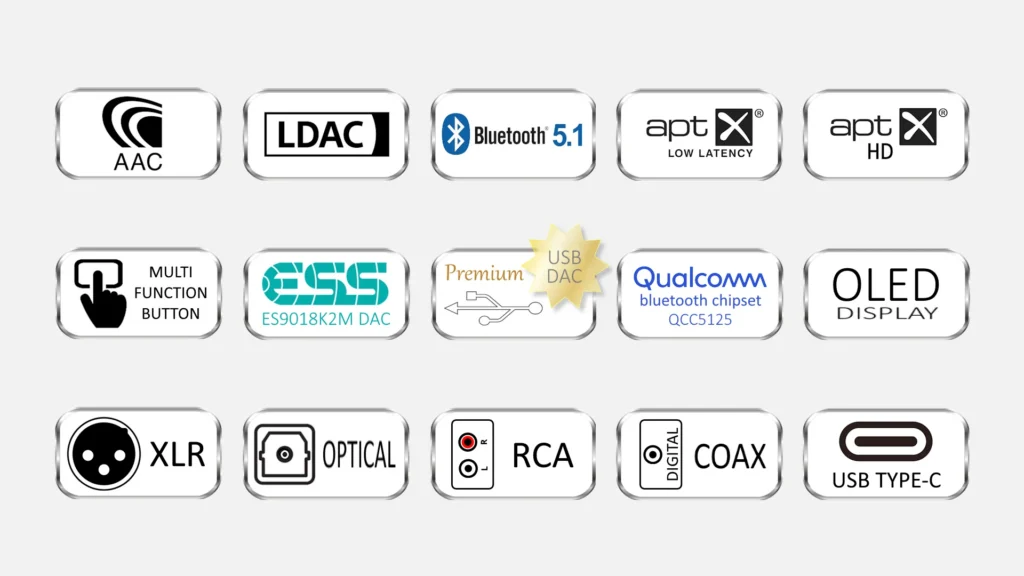
Latency and battery belong in the same paragraph as sound quality. A codec that pushes more bits per second, like LDAC at its top step, needs a cleaner radio link and draws more power; a codec that buffers less, like aptX Low Latency, trades a little fidelity for timing. Receivers publish their codec lists precisely because these tradeoffs are real: matching the codec to the job, hi-res listening at a desk versus lip-synced playback in an edit suite, does more for the experience than any single number on a box.
The catch is symmetric: a codec only runs when both ends support it. An LDAC-capable phone paired with SBC-only headphones streams in SBC. That single rule answers most of the “why do my new earbuds sound the same as the old ones” questions, and it is why receiver makers print the codec list on the box.
Why Does Bluetooth Sometimes Cut Out?
Dropouts trace back, in most cases, to the shared 2.4 GHz band or the path between the two antennas. The common culprits and their fixes:
- Band congestion: a router, a running microwave, and a dozen neighbors’ networks crowd the same frequencies. AFH steers around steady interferers, so moving the phone away from the router or shifting Wi-Fi gear to the 5 GHz band frees room.
- Distance and obstacles: 2.4 GHz waves weaken through walls, floors, and human bodies. Keeping sender and receiver in one room with line of sight restores most links.
- Stale pairings: years of accumulated paired devices can slow some Bluetooth stacks. Removing old pairings from the phone’s Bluetooth menu and re-pairing clears it.
- Codec renegotiation: when a link weakens, devices drop to a lower bitrate, which can sound like a glitch instead of a dropout. Sitting closer to the receiver prevents the renegotiation.
That is the whole machine: a license-free band, fast channel hopping, a pairing handshake, and a codec doing the compression. Knowing how Bluetooth works changes one practical thing for anyone buying audio gear: check the codec list on both ends before paying, match the outputs to the amplifier’s inputs, and treat version numbers as background detail. More on receivers, transmitters, and individual codecs sits in the Bluetooth audio guides on the /learn/ hub.