

What Is a DAC?
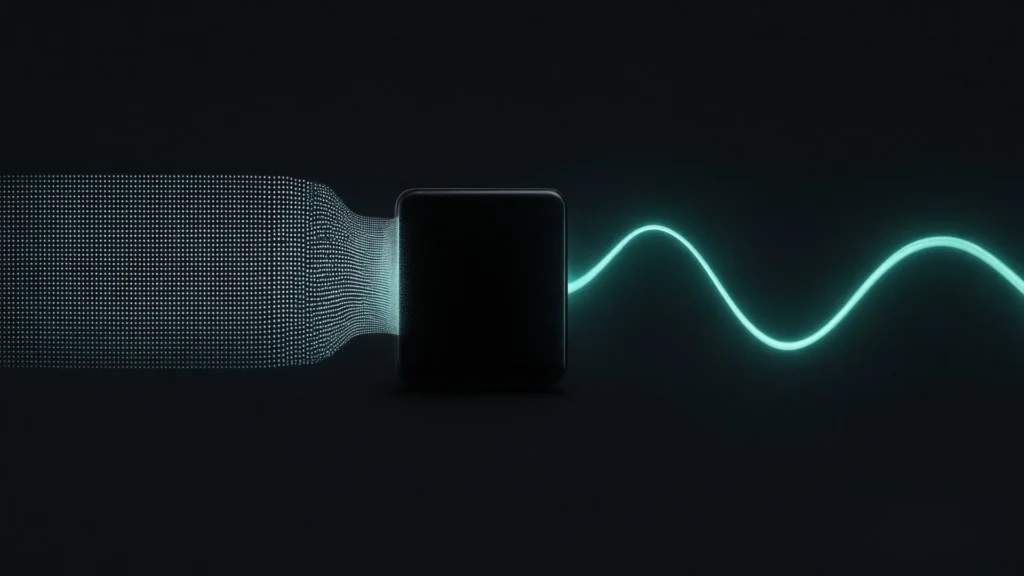
A DAC — short for digital-to-analog converter — is the chip or circuit that turns digital audio, a stream of numbers, into the analog electrical signal that headphones, speakers, and ears can play. Every device that plays digital audio contains one: your phone, your laptop, your CD player, your streamer, and every Bluetooth receiver ever made. Without conversion, stored music is only data; the DAC is where sound physically begins.
Because it sits at the boundary between the digital and analog halves of a system, the DAC’s quality sets a ceiling on everything downstream: no amplifier or speaker can restore detail the conversion lost, or remove hiss the conversion added. That is why converter chips — ESS Sabre, and peers — get named on product pages at all.
You have already met several today without noticing. The earpiece that played a voicemail, the laptop jack that drives a pair of headphones, the soundbar under a TV, the streamer on a hi-fi rack — each contains a converter doing this one job in real time. Most are perfectly competent. The occasions to think about them arrive when something sounds wrong: hiss between tracks, detail that never quite separates, or a system whose only inputs predate the sources you actually use.
Why Digital Audio Needs One
Digital audio files describe sound as measurements — tens of thousands per second, each stored as a number. Speakers, meanwhile, are analog machines: they move air only when fed a continuously varying voltage. Something must translate between the two worlds thousands of times a second, on the fly, without dropping a sample — and that translator is the entire job description of the DAC:
| Digital audio | Analog audio | |
|---|---|---|
| What it is | Numbers — samples measured at a fixed rate (e.g. 44,100 per second) | Voltage — a continuous wave that mirrors the original pressure |
| What it is good at | Storage and transmission without degradation | Driving speakers and ears |
| Where it lives | Files, streams, Bluetooth data | Speaker cables, headphone drivers, air |
| The bridge | The DAC reads the numbers and rebuilds the wave — sample by sample, in real time | |
Two numbers describe the digital side: sample rate (how often the wave is measured — 44.1 kHz for CD, up to 96/192 kHz for hi-res files) and bit depth (how precisely each sample is measured — 16-bit for CD, 24-bit for hi-res). A DAC’s supported rates and depths tell you which files it can rebuild without resampling.
DAC vs Sound Card vs Amp
Three components, three jobs — the confusion comes from them sharing a chassis more often than they share one:
| Component | Job | Typical home |
|---|---|---|
| DAC | Converts digital audio to analog | A chip inside everything, or a dedicated box |
| Sound card | A computer’s audio package — DAC plus output stage plus (often) input, sharing a noisy PC interior | Inside computers and laptops |
| Amplifier | Raises the analog signal’s power to drive speakers or headphones | A hi-fi box, or inside powered speakers |
A sound card contains a DAC — just one sharing cramped space with electrically noisy components, which is why desktop listeners hear hiss from it and upgrade to a purpose-built converter. The amplifier never converts anything; it multiplies whatever analog signal reaches it, noise included. The full comparison — including when each upgrade pays — is in our sound card vs DAC explainer.
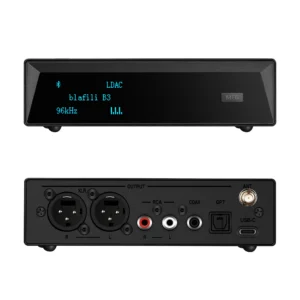
Headphone hardware tells the same story in miniature. A USB “dongle DAC” is nothing more than a small external converter with a headphone amp bolted on — proof that the concept scales down as well as up. And several Bluetooth receivers double in the other direction: their USB-C port accepts digital audio from a computer (16-bit/48 kHz on the blafili B3, XLR, and 6dot35), making the same converter serve a desk setup by day and a hi-fi system by night.
Do You Need a DAC?
Everyone owns several. The question is whether a better one earns its place:
| Situation | Verdict | Why |
|---|---|---|
| Casual listening on a phone or laptop | Built-in is enough | The internal DAC is competent; convenience rules |
| Audible hiss from a computer output | External DAC helps | Moves conversion out of the noisy PC interior |
| Hi-fi system with analog-only inputs | External DAC helps | Adds clean digital inputs to analog gear |
| Adding Bluetooth to a stereo | Choose a receiver with a good DAC | The receiver’s converter becomes your system’s DAC for streaming |
| System with its own DAC/digital input | Digital-output receiver | Let the better converter do the work |
Notice the Bluetooth row: for streaming, the receiver you choose decides which converter your music meets. That makes the buying decision concrete — covered next.
Symptoms point the way better than specs do. Hiss audible between tracks or at idle means the converter (or its output stage) has a high noise floor. A presentation that sounds dull and crowded — instruments stacked instead of placed — often traces to a converter flattening low-level detail. And a system that plays quieter than it should can be starving for clean input level. Any one of these upgrades the answer from “built-in is fine” to “choose the converter deliberately”.
DAC Specs That Matter
Four numbers carry almost all the information. Signal-to-noise ratio (SNR) — how far the music sits above the converter’s own noise floor; higher is cleaner, and hi-fi class sits around 120 dB. Dynamic range — the span between the quietest and loudest passage the converter resolves; the blafili B3’s +127 dB is reference class. THD+N — how much distortion the conversion adds; −120 dB means nothing audible is added at any level. Supported sample rates and bit depths — 32-bit/384 kHz input headroom means hi-res files and LDAC streams pass through without resampling. The same four numbers anchor our Bluetooth DAC guide, with the measured values of a real hi-fi receiver as the worked example.
One reading habit pairs with the numbers: notice which manufacturers publish them. A spec sheet that lists the converter chip, THD+N, and dynamic range is making checkable claims; one that offers only adjectives is not. Silence about measurements is itself information — useful, and free — and it applies to every category on this page, from dongles to receivers.
Where the DAC Lives in a Bluetooth Receiver
A Bluetooth receiver is a DAC with a radio attached — the most common way a converter enters a living-room system today. The chain runs: your phone encodes the music with a codec (SBC, aptX, LDAC), the radio carries the data across the room, the receiver’s decoder unpacks it — and its DAC does exactly what this page describes: numbers in, analog wave out, ready for the output jack. Choose a receiver with RCA/XLR output and its converter becomes your system’s DAC for everything streamed; choose one with optical or coaxial output — like the blafili B3 — and it hands the digital signal to your system’s converter instead. Which receiver architecture fits which system is laid out in the Bluetooth audio receiver guide.