


What a Bluetooth Codec Actually Does
A Bluetooth audio codec is the encoder and decoder that squeezes digital audio into the Bluetooth radio pipe and rebuilds it on the other side. Every Bluetooth audio device ships with SBC, the mandatory baseline; everything else — AAC, the aptX family, LDAC — is an optional layer that both devices must support before they can negotiate it. Which codec survives that negotiation decides how much detail reaches your ears and how far the sound lags the picture.
SBC: The Mandatory Baseline
The Low-complexity Subband Codec streams at roughly 328 kbps with a bitpool-dependent range of 192–345 kbps at 16-bit/48 kHz. Its strengths are efficiency and universality — it is light on batteries and works everywhere. A generous bitpool pushes it toward respectable quality, while a stingy one sounds flat, and its latency makes it a poor fit for gaming.
Deep dive: Mastering the SBC codec · The sub-band codec, explained
AAC: Apple’s Efficient Default
AAC is the codec iPhones and iPads prefer — Apple devices ignore aptX and LDAC entirely. It commonly streams around 256 kbps, sounds nearly identical to 192 kbps MP3 at just 96 kbps, and is tuned hardest on Apple silicon, which is why it often beats higher-bitrate rivals there. It is also the workhorse codec of YouTube and most streaming platforms.
Deep dive: Why your music needs AAC · AAC receivers for audiophiles
aptX: The Android Mainstay
Classic aptX runs at 352 kbps with 16-bit/44.1 kHz audio — “CD-like” fidelity with lower latency than SBC. It requires a license at both ends, so it appears on mid-range and better Android phones and on receivers that advertise it.
Deep dive: aptX wireless Bluetooth adapters · Seven aptX adapter facts
aptX HD: Near-Lossless on Paper
aptX HD raises the bitrate to 576 kbps and carries 24-bit/48 kHz audio — Qualcomm’s “near-lossless” tier for music. It needs aptX HD support on both the phone and the receiver, and it trades some latency for the extra resolution, so it is a music codec first.
Deep dive: What is aptX HD? · aptX HD for audiophiles · aptX vs aptX HD: worth the upgrade?
aptX Low Latency: For Video and Gaming
aptX LL crushes delay to 32–40 ms — below the threshold where most viewers read lip-sync as instant. Both the transmitter and the receiver must support it, which is why it usually appears in matched TV and gaming sets rather than ordinary phone links.
Deep dive: Low latency with the aptX LL receiver · The best aptX LL receivers
aptX Adaptive: The Codec That Compromises Smart
aptX Adaptive shifts between roughly 279 and 420 kbps as the link allows and drops under 80 ms in its low-latency mode — one codec for music and video on newer Android phones and recent receivers.
Deep dive: How aptX Adaptive works
LDAC: The Hi-Res Flagship
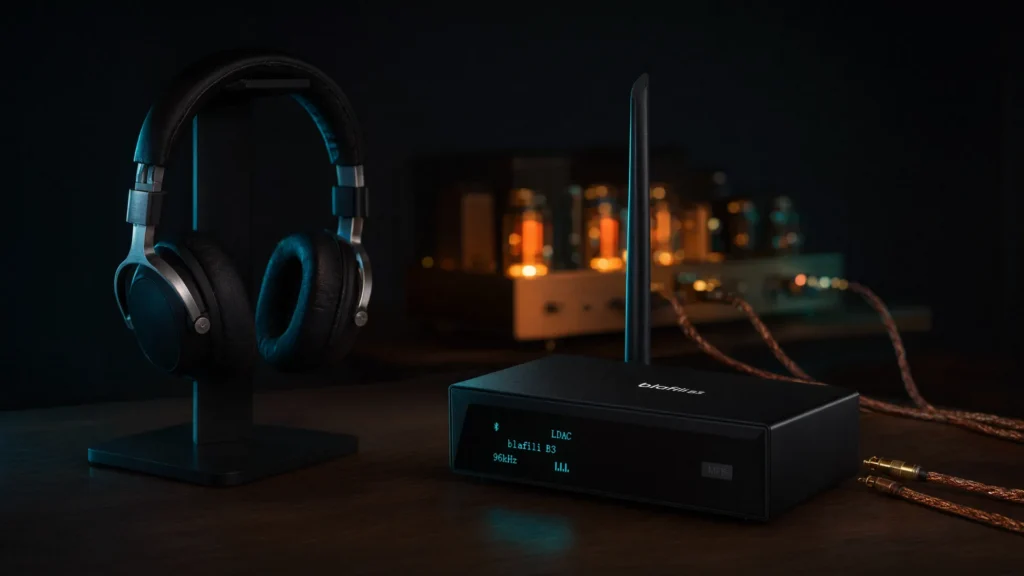
Sony’s LDAC documents three connection modes — 330, 660, and 990 kbps — and accepts up to 24-bit/96 kHz input. It is built into Android since 8.0 and appears mainly on Sony and hi-res-oriented gear. The highest mode preserves the most detail; the link downshifts automatically when radio conditions degrade.
Deep dive: What is the LDAC codec? · LDAC vs AAC for music lovers · LDAC Bluetooth audio receivers
The Full Comparison Table
| Codec | Max bitrate | Audio format | Typical latency | Where you’ll meet it | Best for |
|---|---|---|---|---|---|
| SBC | ~328 kbps (bitpool-dependent, up to 345) | 16-bit/48 kHz | Highest (~200 ms) | Every Bluetooth audio device (mandatory) | Calls, podcasts, casual music |
| AAC | ~256–320 kbps | 16-bit/44.1–48 kHz | Moderate; best tuned on Apple hardware | iPhone/iPad, YouTube, many earbuds | Apple-centric listening |
| aptX | 352 kbps | 16-bit/44.1 kHz | Lower than SBC | Many Android phones and receivers | Everyday Android music |
| aptX HD | 576 kbps | 24-bit/48 kHz | Moderate | Hi-fi receivers, some Android phones | Hi-res listening on Android |
| aptX Low Latency | Optimized for speed | 16-bit/48 kHz | 32–40 ms | Transmitter + receiver pairs for TV | Video and gaming |
| aptX Adaptive | 279–420 kbps (dynamic) | Scales with the link | Under 80 ms in low-latency mode | Newer Android phones and recent receivers | Mixed music and video |
| LDAC | 330 / 660 / 990 kbps modes | Up to 24-bit/96 kHz | Higher in the 660/990 modes | Sony hardware, Android 8.0+ | Hi-res streaming on Android |
These numbers describe ceilings, not guarantees: the codec both ends negotiate, the selected LDAC mode, radio conditions, and the rest of the audio chain decide what you actually hear. Distance, interference, and source quality matter as much as the label — and the receiver, its DAC and output stage included, is the other half of that chain; our Bluetooth audio receiver guide covers how to pick one.
Which Codec Should You Use?
- iPhone or iPad: AAC is the only game in town — Apple ignores aptX and LDAC.
- Android + hi-res streaming (Tidal, Qobuz): LDAC, with aptX HD a close second.
- Movies and gaming: aptX Low Latency or aptX Adaptive, with support at both ends.
- Mixed households: a receiver carrying LDAC, aptX HD, and AAC covers nearly every phone.
- Everything else: SBC is the fallback — fine for calls, podcasts, and casual listening.
How to Check Which Codec Is Active
Verify the codec in use during playback instead of trusting a settings label: on Android, enable Developer Options and open the Bluetooth audio codec selector while playing; many receivers also indicate the active codec on their display or LED. iPhones do not expose the active codec — on Apple hardware it is AAC. A receiver’s spec sheet tells you what it can use; the negotiation with your source decides what it does use.
Codec Comparison Tool
An interactive chooser that matches your phone to a receiver and lists the codecs the pair can actually negotiate is on the roadmap. Until it ships, the table above plus the codec check answer most questions.