

What a DAC Does (and Why Every Bluetooth Receiver Has One)
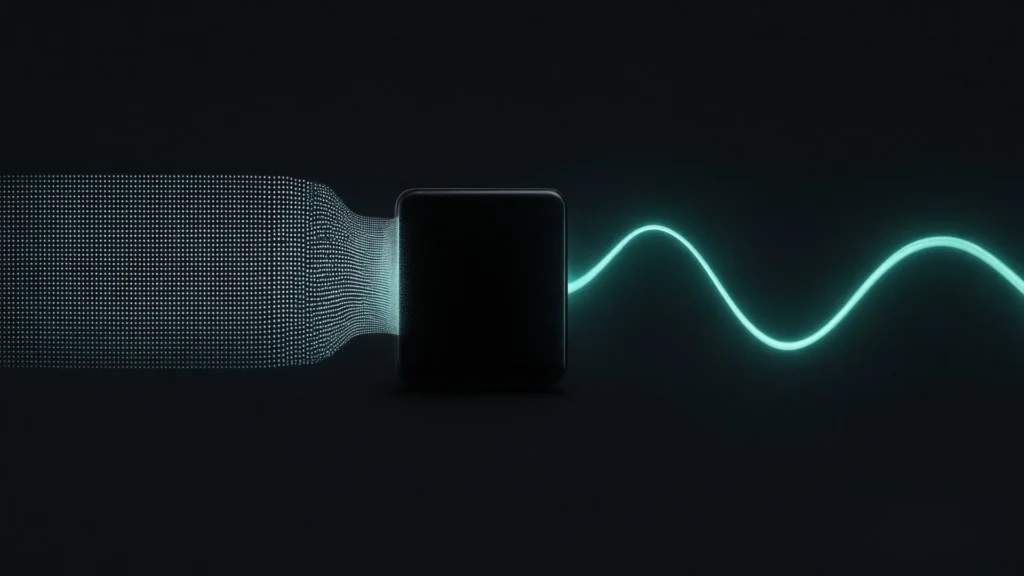
A DAC — digital-to-analog converter — turns the numbers of digital audio into the electrical signal speakers and ears need, and every Bluetooth receiver contains one because Bluetooth delivers nothing but numbers. Your phone encodes the music, the radio carries the data, and the receiver’s DAC is where sound physically exists again. Its output stage then drives the cable to your amp or powered speakers.
That placement makes the DAC the most consequential chip in the box: codecs and radios move data, but the DAC sets the ceiling on how clean and detailed the analog signal can be. The concept is short enough for one page — see what is a DAC for the plain-language version, and our sound card vs DAC breakdown for why a dedicated converter outperforms the one squeezed inside a noisy computer.
Bluetooth raises the DAC’s stakes rather than lowering them. When your phone plays through its own headphone jack, its internal DAC does the conversion; the moment a Bluetooth receiver enters the picture, the phone’s converter is bypassed entirely and the receiver’s DAC becomes the one your music meets. That is why two receivers fed by the same phone can sound different, and why the receiver’s spec sheet — not the phone’s — is where the analog quality of a wireless system is decided.
Do Bluetooth Receivers Affect Sound Quality?
Yes — through three stages, in this order of audibility: the codec that carries the stream, the DAC that rebuilds it, and the output stage that drives the cable. The codec decides how much data survives the trip: SBC is the mandatory floor, while aptX HD and LDAC preserve dramatically more detail when both ends support them. The DAC decides how faithfully those numbers become analog — a weak converter adds hiss and flattens space even when the codec was perfect. The output stage decides what reaches the cable: noise here, past any rescue, becomes audible hiss between tracks.
Calibrated against reality: a clean modern receiver with HD codecs plays indistinguishably from a wired source for most listeners on most recordings, while a bargain dongle with an unnamed DAC audibly does not. The differences between those two products are exactly the three stages above — which is why the receiver-vs-standard-receiver question has a real answer, covered in Bluetooth DAC receiver vs standard receiver.
Hi-Res Codecs and the DAC
Hi-res wireless sound is a relay: the codec carries what the DAC must ultimately deliver. LDAC, Sony’s hi-res codec, streams at up to 990 kbps and accepts up to 24-bit/96 kHz input — Android has it built in since 8.0. aptX HD carries 24-bit/48 kHz at 576 kbps. Both hand the DAC far more data than SBC’s ~328 kbps, which is why the codec badge on the box matters only when the DAC behind it can use the extra resolution.
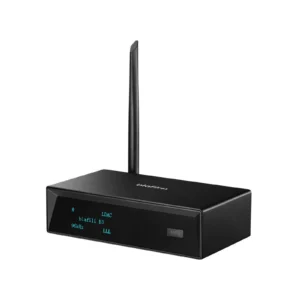
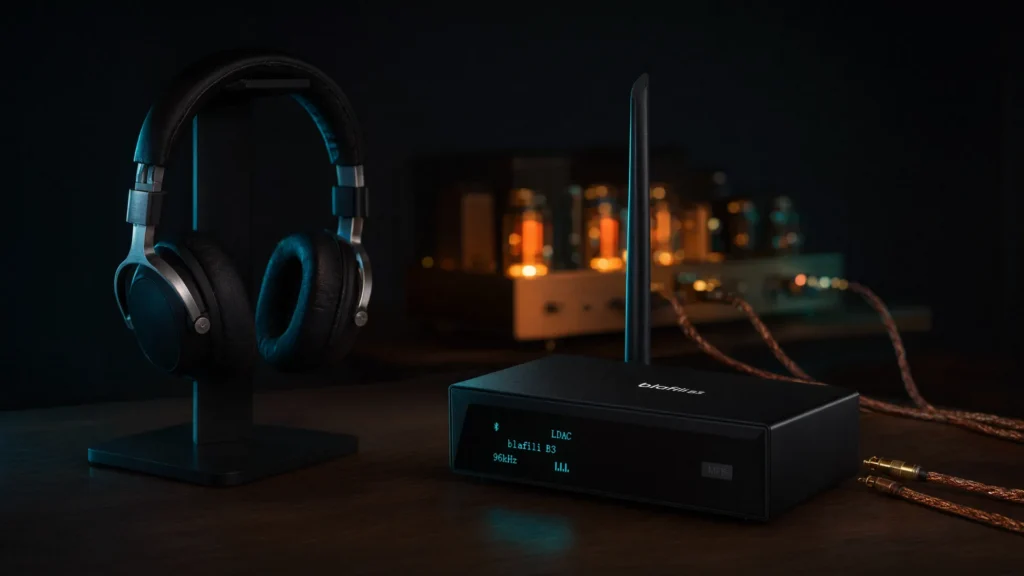
The numbers on a receiver’s spec sheet describe input headroom: a receiver rated for 32-bit/384 kHz PCM over LDAC — like the blafili B3 — accepts everything the codec can hand it and never becomes the bottleneck mid-chain. The full codec-by-codec numbers live in our codec comparison, and the LDAC deep dive is in what is the LDAC codec; the wireless-hi-res implications are unpacked in wireless hi-res BT DACs.
Negotiation deserves one honest paragraph, because codec badges oversell it. LDAC is not one bitrate but three modes — 330, 660, and 990 kbps — and the link shifts between them as radio conditions allow, dropping a hi-res file into a lower mode the moment the air gets crowded. The DAC does not care which mode arrives; it resolves whatever data survives. Practically: place the receiver within a room of the phone, away from the Wi-Fi router, and the link spends its life in the top mode that made you choose the codec in the first place.
Inside a Hi-Fi Bluetooth DAC: the blafili B3
Specifications beat adjectives, so here is what a hi-fi Bluetooth DAC actually contains — measured values from the blafili B3:
| Stage | Component / spec | What it buys you |
|---|---|---|
| DAC core | ESS ES9018K2M | Reference-class Sabre converter — the same chip family used in dedicated hi-fi DACs |
| Distortion | THD+N −120 dB | Harmonic distortion below the hearing threshold at any listening level |
| Dynamic range | DNR +127 dB | Quiet passages stay separated from loud ones; no audible noise floor between tracks |
| Input headroom | Bluetooth PCM (LDAC) up to 32-bit / 384 kHz | Accepts the full LDAC stream without resampling |
| Radio | Qualcomm QCC5125, Bluetooth 5.1 | Stable link for LDAC/aptX HD negotiation; RP-SMA antenna for range |
| Outputs | Balanced XLR / RCA / optical / coaxial | Feeds analog hi-fi and digital-input systems from one box |
| Codecs | LDAC, aptX HD, aptX LL, aptX, AAC, SBC | Negotiates the best mode every source device supports |
Two of these rows do the audible heavy lifting. The ES9018K2M’s −120 dB THD+N means the converter adds no character of its own — what the codec delivered is what the amplifier receives. And the +127 dB dynamic range is why the B3 stays silent between tracks on efficient speakers where lesser converters hiss. For the concepts behind the numbers, DAC, digital, and analog covers the conversion itself.
Read any spec sheet the same way, including ours. Adjectives are free — “studio-grade”, “hi-fi sound” — but a named chip, a THD+N figure, and a dynamic range number cost a manufacturer something: they are claims a lab can check. The presence of those three lines predicts clean output better than any marketing sentence, and their absence predicts the opposite. That habit — trust published numbers over descriptions — is the whole method behind the buying table that follows.
How to Choose a Bluetooth DAC
| Spec to check | What good looks like | Why it matters |
|---|---|---|
| Named DAC chip | A real part number (ESS ES9018K2M, and peers), not “high-fidelity converter” | The single best predictor of measured and audible cleanliness |
| Signal-to-noise / THD+N | Stated figures, e.g. −120 dB THD+N | If a listing hides both, hiss complaints in reviews are the data |
| Dynamic range | ~120 dB class for hi-fi use | Separation of quiet and loud; silence between tracks |
| Codec list | LDAC and/or aptX HD — matching your phone | The codec and DAC only deliver together |
| Output set | Match your system: RCA, XLR, optical/coaxial | The best DAC is useless into the wrong jack |
| Power | USB-C with pass-through, or battery hours | Permanent installs need use-while-plugged-in |
The buying checklist condenses to: named chip, published numbers, the right outputs, and codecs your phone actually speaks. More buying-side reading: the audiophile’s Bluetooth DAC buying guide, how to pick the perfect Bluetooth DAC, and the pro-angle best Bluetooth DAC with XLR for pro sound. The role a DAC converter plays in a chain is covered in why you need a Bluetooth DAC converter.
One architectural choice sits above the rest of the checklist: where you want the conversion to happen. An analog-output receiver (RCA, XLR, 3.5 mm) uses its own DAC — right for stereos and powered speakers whose only inputs are analog. A digital-output receiver (optical, coaxial) skips its analog stage and hands the decoded stream to your system’s converter — right for AV receivers, soundbars, and outboard DACs that already own a good one. Units like the B3 carry both routes, which is the quiet reason four-output receivers anchor so many systems: the architecture decision stops being a constraint.
Setup Tips: Gain, Cabling, and Ground Loops
Gain staging. Let the digital side run strong: keep the phone’s volume fairly high and ride the listening level on your amplifier’s knob. If the sound distorts, step the phone back a notch — an overdriven input cannot be equalized clean. On receivers with multiple outputs, prefer the balanced XLR for long runs and let the optical or coaxial jack bypass the analog stage entirely when your system has its own DAC.
Cabling and hum. Keep signal cables away from power bricks, and power the receiver from the same strip as the amplifier — that single habit prevents the classic ground loop hum, whose full fix list lives in the RCA guide’s fixes section. Vintage-system owners get the scene-specific version in the old-stereo guide. And when the music is streamed rather than played from files, the DAC’s role in Bluetooth music streaming explains where the conversions happen end to end; the listening-room payoff is described in audiophile DAC + Bluetooth hi-fi and how DAC and Bluetooth revolutionize sound.
Placement. A converter with a good radio still wants clear air: set the unit on the shelf top rather than tangled behind it, keep the antenna vertical when the receiver carries one (the B3’s RP-SMA antenna is removable precisely so it can be positioned), and a hand’s width of space around the case keeps the output stage cool during long sessions. None of this is audiophile ritual — it is the same reasoning as the negotiation paragraph above, applied one meter at a time.