

A Bluetooth DAC is the digital-to-analog converter inside a wireless receiver: the chip that takes the numbers arriving over the radio and rebuilds them as the analog signal your amplifier plays. Every Bluetooth receiver carries one, because Bluetooth delivers nothing but numbers, and a Bluetooth DAC receiver worth the name states which chip does the converting and how cleanly it does so.
This page is the buying-decision half of the Bluetooth DAC topic: what the converter actually contributes, which measurements separate clean units from noisy ones, and how to match one to a real system. The general anatomy of receivers has its own page, the Bluetooth audio receiver guide; this one stays on the converter and the decision. Prices in this niche run from $21.99 for a basic RCA hookup to $109 for a box with balanced and digital outputs, so the ladder is short and the differences are specific.
What Is a Bluetooth DAC?
A Bluetooth DAC, in one sentence, is the converter stage of a wireless receiver: the circuit that takes decoded digital audio and turns it into the analog voltage a stereo, mixer, or pair of powered speakers can play. The name gets attached to the whole box because on better receivers the converter is the part worth naming. When a listing says the unit carries an ESS ES9018K2M, it is telling you exactly which chip performs the final job in the chain.
What the term covers is broader than one shape. A Bluetooth DAC can be a desktop box with jacks for a stereo, a battery stick that feeds a mixer, or a USB dongle built for headphones; the converter inside is the common thread, and the rest of the chassis exists to deliver its output somewhere useful. This page concentrates on the receiver form, the boxes that feed home and pro systems, because that is where the buying questions concentrate too.
The process itself is simple and old. Stored or streamed music is a series of numbers, amplitude samples taken at fixed intervals, and a speaker cone can only move to a voltage. A DAC digital analog converter bridges the two, reading the samples and outputting a smooth continuous waveform. A better chip adds less noise and less of its own character, and that restraint is the whole art of a Bluetooth DAC; a cheap one stamps everything passing through it with hiss and a hard treble edge. For the concept in full, the what is a DAC explainer covers sampling, bit depth, and conversion without the shopping layer.
Why does the converter matter more over Bluetooth than over a cable? Because a phone that streams bypasses its own DAC entirely. Wired listening uses the converter inside the phone; wireless listening hands the job to whichever chip sits inside the receiver. That answers a common support question we see: a listener upgrades headphones, the sound stays flat, and Bluetooth gets the blame. More often the weak link is the unnamed converter at the receiving end, not the radio. Phone makers squeeze that converter in beside processors and radios and spend the budget on the screen; a dedicated box gives the same job a proper chip, a quieter power supply, and real output circuitry, which is the whole case for a dedicated Bluetooth DAC.
Does the DAC Affect Bluetooth Sound Quality?
Yes, and it helps to keep two layers separate, because they fail in different ways. The codec layer decides how much detail survives the radio trip: it packs the audio, trades fidelity for bandwidth, and unpacks it at the receiver. The conversion layer is the Bluetooth DAC at work, backed by the output stage, and it decides how cleanly the surviving detail becomes a signal at the jack. The DAC digital analog handoff is where numbers finally turn into voltage, and a poor one hisses and flattens the sound at any bitrate, while a good one gets out of the way. A third factor sits behind the converter: the output stage, the circuit that actually drives the cable. It sets the output level, the impedance the next component sees, and how much noise rides along the signal. A superb DAC chip behind a careless output stage still hisses on efficient speakers, which is why the cable and power notes near the end of this page matter as much as any chip name.
| Codec | Top rate | What the receiver’s DAC receives |
|---|---|---|
| LDAC | up to 990 kbps, 96 kHz/24-bit | the largest stream Bluetooth currently carries |
| aptX HD | 576 kbps, 48 kHz/24-bit | detail-focused Android listening |
| aptX Low Latency | 420 kbps | music with latency held near 40 ms |
| AAC | 320 kbps | the default path from iPhones |
| SBC | 328 kbps | the universal baseline every device speaks |
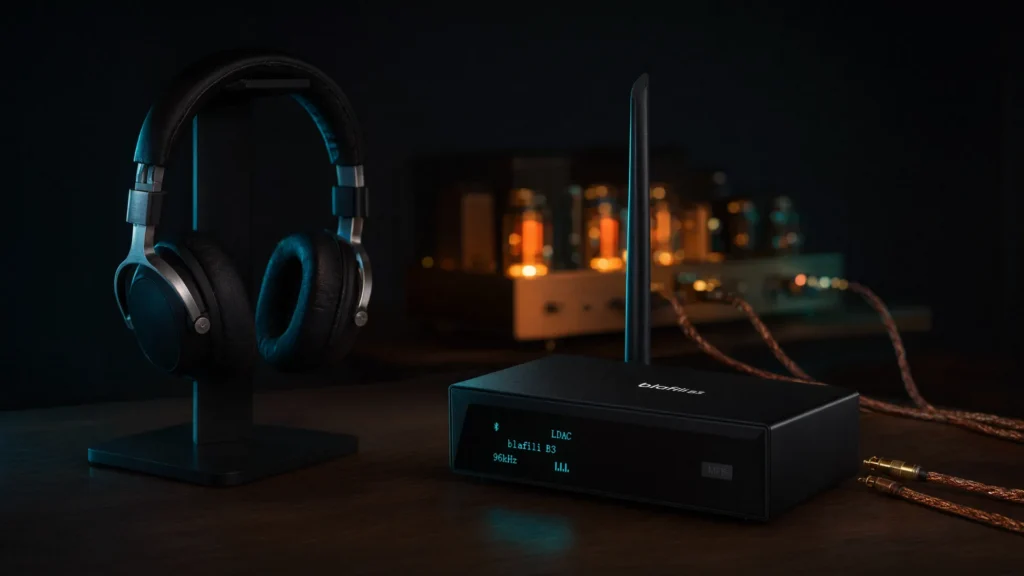
Two honest notes on that table. First, the link negotiates: it settles on the best codec both ends share, so an Android phone that can send LDAC does, and an iPhone lands on AAC whatever the box claims. The codec-by-codec breakdown lives in our Bluetooth codec comparison, and a complete LDAC chain is walked through in the LDAC receiver with SPDIF and optical output guide. Second, bitrate is a ceiling, not a promise. The codec decides what arrives; the Bluetooth DAC decides what you hear of it. A Bluetooth DAC receiver whose converter upsamples to 32-bit/384 kHz, like the blafili B3, accepts the whole stream without becoming the bottleneck mid-chain, while a converter that truncates or reshapes the data wastes what the codec delivered.
Set against reality: a clean chain with LDAC or aptX HD at both ends comes close to a wired source for most listeners on most systems, and wired keeps the theoretical edge, the gap an audiophile with a reference setup might still hear. What no converter can do is re-create detail the codec already threw away. The realistic goal of a good Bluetooth DAC is a silent background, stable stereo imaging, and treble that stops annoying you an hour into a session; those are converter traits, and they are what the spec numbers in the next section predict.
How to Choose a Bluetooth DAC
The method for judging any Bluetooth DAC costs nothing: trust published numbers over adjectives. A maker that names its chip and prints THD+N and dynamic range is making claims a lab can check; one that writes “premium sound” instead is telling you it would rather you not measure. Work down this checklist:
| Spec to check | What good looks like | Why it matters |
|---|---|---|
| Named DAC chip | a real part number, such as the ESS ES9018K2M | the best single predictor of a quiet converter |
| THD+N | stated, for example -120 dB | the distortion the converter adds to everything |
| Dynamic range | stated, for example +127 dB | silence between tracks; quiet passages stay audible |
| Codec list | LDAC and/or aptX HD, matched to your phone | codec and converter only deliver together |
| Outputs | XLR, RCA, optical, coaxial, matched to a free input | the best DAC is useless into the wrong jack |
| Power | USB-C, battery hours, or pass-through operation | permanent installs need use-while-charging |
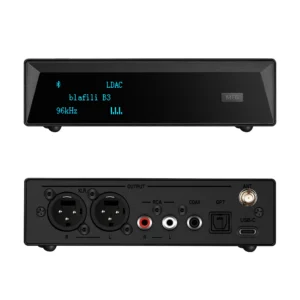
On a real spec sheet, those rows look like this, from the blafili B3 at $109:
| Stage | Measured spec |
|---|---|
| DAC core | ESS ES9018K2M |
| Distortion | THD+N -120 dB |
| Dynamic range | +127 dB |
| Upsampling | 32-bit/384 kHz |
| Radio | Qualcomm QCC5125, Bluetooth 5.1 |
| Outputs | balanced XLR, RCA, optical, coaxial |
| Codecs | LDAC, aptX HD, aptX LL, aptX, AAC, SBC |
Two rows do the audible work. THD+N of -120 dB means the converter adds effectively no character of its own, so what the codec delivered is what the amplifier receives; +127 dB of dynamic range is why the unit stays silent between tracks on efficient speakers where lesser converters hiss. The B3 rates 4.9 out of 5 across 186 reviews, so the paper numbers are holding up in living rooms, and the four outputs let one box feed analog and digital systems at once.
Do you need an XLR DAC?
An XLR DAC earns its keep when the receiver feeds balanced inputs: mixers, powered PA cabinets, studio monitors, or any cable run longer than a few meters, where the balanced connection rejects hum that unbalanced cable would pick up. The blafili XLR at $40.99 is the direct fit: an XLR output, aptX HD and aptX Low Latency on board, a built-in 320 mAh battery good for up to 16 hours of playback, and 4.9 out of 5 across 68 reviews, in a 40 g body. The pro-side details are in our XLR Bluetooth receiver guide. If every input you own is RCA or aux, skip the XLR jack and spend on the converter itself.
Outputs decide where conversion happens
One architectural choice sits above the checklist: should the box convert, or should your system? An analog-output Bluetooth DAC receiver uses its own converter, which suits stereos and powered speakers with line inputs. A digital-output receiver passes the decoded stream over optical or coaxial to the DAC already inside an AV receiver, soundbar, or outboard converter, skipping its own analog stage entirely. Units that carry both routes, like the B3, end up anchoring mixed systems because the decision stops being a constraint.
What audiophile buyers check
Audiophile readers treat a Bluetooth DAC like any other converter: named chip, published distortion and dynamic range figures, a clean power supply, and balanced output where runs are long. What those numbers buy in practice is a black background, stable imaging, and less fatigue at the end of a long session, which is also why the spending question has a ceiling. Past a well-measured mid-range unit the returns shrink, so match the spend to the system: a measured $40.99 unit into studio monitors outperforms a flagship converter behind a budget amp. Headphone rigs follow the same logic: a Bluetooth DAC amp pairing, receiver into a small headphone amplifier, keeps conversion and gain in separate competent stages instead of asking one dongle to do both jobs.
The ladder across our own line is short and honest: the blafili R1 at $21.99 for a basic RCA hookup, the XLR at $40.99 for balanced or battery-powered use, and the B3 at $109 for the flagship Bluetooth DAC in the range, with the named chip, LDAC, and four outputs in one box.
Setup notes: gain, cabling, and power
Three habits protect the numbers you paid for. Set gain in the right order: keep the phone’s volume strong and ride the listening level on the amplifier’s knob, because an overdriven input cannot be corrected later in the chain. Prefer the balanced XLR output for long runs and the optical or coaxial jack when the next component owns a good converter of its own; fiber also picks up none of the electrical hum copper can. And power the receiver from the same strip as the amplifier: the classic ground-loop hum that shows up after adding a wireless source usually comes from two wall outlets, not from the converter.
Where a Bluetooth DAC Earns Its Keep
Four scenes account for most Bluetooth DAC purchases, and each stresses a different part of the box.
Home hi-fi systems
An integrated amp or stereo with a free line input is the default scene. The receiver occupies one input the way a CD player once did, the phone stays in a pocket, and a rated range up to 100 feet covers most homes. An audiophile system that already owns a good converter takes the optical or coaxial feed and hands conversion to the trusted gear; everything else takes RCA or XLR and lets the Bluetooth DAC do the work. Desk and office systems follow the same logic in miniature, where a compact USB-powered unit keeps the whole chain to one cable and a plug.
PA and pro sound
Live-sound work is where a Bluetooth DAC faces demands a living room never makes. Background music and break sets into a mixer want a balanced feed that stays quiet along a stage-length cable, and dynamic range is the spec that matters most: quiet passages audible without riding the master fader, and no converter hiss between songs. With aptX Low Latency in the chain, video playback at events stays in sync at a latency near 40 ms. This is the scene where an XLR DAC stops being a luxury and becomes the correct connector for the job.
Portable listening
A battery-powered Bluetooth DAC takes the conversion quality out of the house: hotel stereos, a car aux input, a friend’s mixing setup, a workshop radio. The blafili XLR is the template, its 320 mAh cell running up to 16 hours on a charge of about 2 hours, at 40 g light enough to forget in a jacket pocket. A USB-powered unit is happy on any power bank; a built-in battery removes the outlet from the equation entirely.
Wireless without rebuilding the rack
The quieter argument for the category is architectural. A Bluetooth DAC lets a phone join an existing system without a new source component, a dock, or a cable run through the house; add a second receiver to another room’s amp and the same library follows you, at a fraction of the cost and complexity of rebuilding each room around streaming hardware. Every current blafili receiver can carry a custom broadcast name, so “Living room” and “Garage” stay straight in a pairing list, and on the B3 a pairing password can keep neighbors and guests off the system.
Receiver with DAC vs Standard Receiver vs Dongle
A Bluetooth DAC receiver and a standard receiver do the same radio job; the difference is whether the maker names the converter and publishes its numbers, which is what predicts the noise floor. If the chip is named and measured, the Bluetooth DAC label is earned; if not, you are buying a standard receiver with marketing on top. A dongle DAC is the same conversion idea in stick form: headphone- and laptop-oriented, it trades antenna room and output jacks for pocketability, and its USB plug usually feeds a computer rather than a stereo. The forms overlap less than the search results suggest: a dongle rarely carries balanced or digital outputs, and a receiver box rarely clips onto a keychain, so the system you feed usually settles the question before the budget does.
| Form | What it is | Best fit |
|---|---|---|
| Bluetooth DAC receiver | named converter chip, line-level outputs | stereos, amps, powered speakers, PA |
| Standard Bluetooth receiver | same radio, unnamed converter, analog-only output | casual aux upgrades led by price |
| Dongle DAC | stick-format converter, often USB-powered | laptops and headphones on the move |
The fuller comparison, measurement by measurement, is its own article: Bluetooth DAC receiver vs standard receiver.
Bluetooth DAC Pitfalls to Avoid
- Codec mismatch. LDAC printed on the Bluetooth DAC box means nothing unless the phone sends it and the link holds the top mode; an iPhone lands on AAC whatever the receiver claims. Check both spec sheets before paying for a codec list.
- Hidden specs. A listing that names no chip and prints no THD+N or dynamic range is the kind of Bluetooth DAC that hisses. Treat review mentions of background noise as the data the spec sheet left out.
- Wrong output architecture. RCA-only into a system with optical inputs, or a digital-output receiver into an amp with no converter, strands the signal. List your free inputs before you list prices.
- Cheap power. A hum that appears with a new USB supply is usually a ground loop rather than a broken converter. Power the receiver and the amp from one strip, and keep signal cables away from power bricks.
- Gain staging backwards. When distortion appears, lower the phone volume first and bring the amplifier up after; the reverse order lifts the noise floor along with the signal.
- Spending past the system. The belief that the most expensive converter always wins does not survive contact with a modest amp and speakers. A well-measured unit matched to its system beats a flagship bolted onto budget gear.
The checklist, in order: match outputs to a free input, read the codec list against your phone, demand a named chip with published THD+N and dynamic range, then choose the power that fits the scene. The five receivers in the current blafili receiver lineup cover that ladder from $21.99 to $109, and every Bluetooth DAC among them ships with free shipping on all orders, backed by a 2-year warranty and 30-day returns.